Walk into any sock drawer and you’ll find the eternal debate: ankle or crew? Both have earned their place in our daily rotation, but understanding what sets them apart can transform how you think about this wardrobe staple.
At Pournara, we’ve been crafting premium socks in Greece since 1949, so we know a thing or two about what makes each style tick. Here are the seven differences that actually matter.
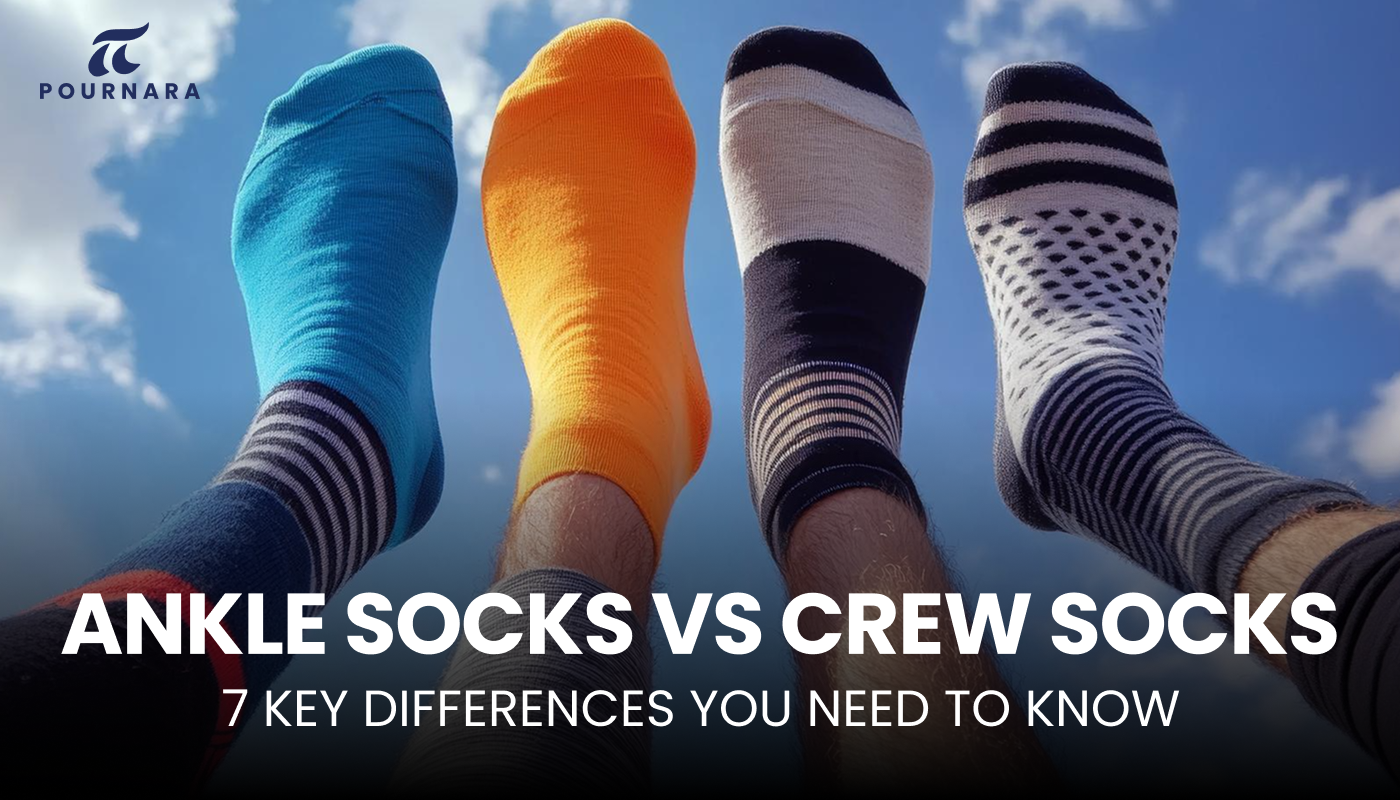
The most obvious difference sits right in the name. Crew socks rise to mid-calf, typically landing 6-8 inches above your shoe. Ankle socks stop just above the ankle bone, barely peeking over your footwear.
This height gap changes everything from how socks feel to where you can wear them. Crew socks wrap more of your lower leg, while ankle socks keep things minimal. Think of it as the difference between a turtleneck and a crew neck shirt, same basic function, totally different vibe.
Your climate should influence your sock drawer more than you’d think. Crew socks bring extra coverage that traps warmth, making them a natural fit for chilly mornings or full-blown winter. That extended fabric acts like insulation for your lower legs.
Ankle socks work with your body instead of against it during warmer months. Less material means better airflow around your ankles and feet. Anyone who’s walked through Athens in August wearing the wrong socks knows this lesson well. When temperatures climb, ankle socks become your cooling system.
Your day’s plans should guide your sock choice. Crew socks provide stability for high-impact activities, hiking rugged trails, playing basketball, or spending hours in work boots. The extra length prevents your socks from sliding down into your shoes, and many crew styles include cushioning that extends up the leg.
Ankle socks shine during activities where you need agility over protection. Running, gym sessions, or casual walking all benefit from the lightweight design. You get adequate foot support without the bulk around your calves. At Pournara, we craft our ankle socks with reinforced heels and arches, so you still get performance without the extra height.
Crew socks match naturally with boots, high-tops, and dress shoes. They fill the space between your shoe and pants hem, creating a finished look. You won’t accidentally flash skin when you sit down or cross your legs, a real concern in formal settings.
Ankle socks pair perfectly with sneakers, loafers, and boat shoes. They stay hidden or barely visible, giving you that clean, modern aesthetic many people prefer. Low-profile footwear looks better without sock fabric bunching at the opening.
Here’s something most people overlook: crew socks shield more skin. Working outdoors? Those extra inches protect against scratches from brush, insect bites, and general wear. They also reduce friction between your leg and tall boots.
Ankle socks offer targeted protection where shoes typically cause problems, heels, toes, and arches. But your lower legs stay exposed. This matters less if you’re wearing shorts or spending time indoors, but it’s worth considering for outdoor activities.
Business environments tend to favor crew socks, particularly for men’s formal wear. Showing a bare leg between your pants and shoes reads as casual or incomplete. Crew socks maintain coverage even when you sit, keeping your look polished through long meetings.
Ankle socks work fine for business casual settings or creative workplaces, especially during summer. Paired with chinos or lighter fabrics, they can look intentional rather than underdressed. The key sits in reading your office culture.
Both styles come in similar fabrics, cotton, merino wool, bamboo, but how those materials perform changes with sock length. Crew socks need more substantial construction to prevent sagging. At Pournara, we use 220-260 knitting needles compared to the industry standard of 120-200, creating denser fabric that holds its shape.
Our Anesis Collection features 100% mercerized cotton with innovative elastic weaving that needs zero nylon. This matters more in crew socks where elastic failure means constant pulling up throughout your day. Ankle socks use less material overall, but they still require quality construction at stress points like heels and toes.
Check out this article, Benefits of Wearing Bamboo Socks.
You don’t need to choose one style forever. Most people benefit from owning both and switching based on the situation. Keep crew socks ready for formal occasions, cold weather, and activities needing extra coverage. Stock ankle socks for warm days, athletic pursuits, and casual looks with low-cut shoes.
Quality matters regardless of length. Pournara’s 75-year heritage means we’ve learned what makes socks last, needle count, premium materials, and construction that respects your feet. Whether you reach for an ankle or crew, you deserve socks that perform.
Your feet carry you through life. Give them the right foundation, and everything else follows.
Pournara
We firmly believe that the internet should be available and accessible to anyone, and are committed to providing a website that is accessible to the widest possible audience, regardless of circumstance and ability.
To fulfill this, we aim to adhere as strictly as possible to the World Wide Web Consortium’s (W3C) Web Content Accessibility Guidelines 2.1 (WCAG 2.1) at the AA level. These guidelines explain how to make web content accessible to people with a wide array of disabilities. Complying with those guidelines helps us ensure that the website is accessible to all people: blind people, people with motor impairments, visual impairment, cognitive disabilities, and more.
This website utilizes various technologies that are meant to make it as accessible as possible at all times. We utilize an accessibility interface that allows persons with specific disabilities to adjust the website’s UI (user interface) and design it to their personal needs.
Additionally, the website utilizes an AI-based application that runs in the background and optimizes its accessibility level constantly. This application remediates the website’s HTML, adapts Its functionality and behavior for screen-readers used by the blind users, and for keyboard functions used by individuals with motor impairments.
If you’ve found a malfunction or have ideas for improvement, we’ll be happy to hear from you. You can reach out to the website’s operators by using the following email
Our website implements the ARIA attributes (Accessible Rich Internet Applications) technique, alongside various different behavioral changes, to ensure blind users visiting with screen-readers are able to read, comprehend, and enjoy the website’s functions. As soon as a user with a screen-reader enters your site, they immediately receive a prompt to enter the Screen-Reader Profile so they can browse and operate your site effectively. Here’s how our website covers some of the most important screen-reader requirements, alongside console screenshots of code examples:
Screen-reader optimization: we run a background process that learns the website’s components from top to bottom, to ensure ongoing compliance even when updating the website. In this process, we provide screen-readers with meaningful data using the ARIA set of attributes. For example, we provide accurate form labels; descriptions for actionable icons (social media icons, search icons, cart icons, etc.); validation guidance for form inputs; element roles such as buttons, menus, modal dialogues (popups), and others. Additionally, the background process scans all the website’s images and provides an accurate and meaningful image-object-recognition-based description as an ALT (alternate text) tag for images that are not described. It will also extract texts that are embedded within the image, using an OCR (optical character recognition) technology. To turn on screen-reader adjustments at any time, users need only to press the Alt+1 keyboard combination. Screen-reader users also get automatic announcements to turn the Screen-reader mode on as soon as they enter the website.
These adjustments are compatible with all popular screen readers, including JAWS and NVDA.
Keyboard navigation optimization: The background process also adjusts the website’s HTML, and adds various behaviors using JavaScript code to make the website operable by the keyboard. This includes the ability to navigate the website using the Tab and Shift+Tab keys, operate dropdowns with the arrow keys, close them with Esc, trigger buttons and links using the Enter key, navigate between radio and checkbox elements using the arrow keys, and fill them in with the Spacebar or Enter key.Additionally, keyboard users will find quick-navigation and content-skip menus, available at any time by clicking Alt+1, or as the first elements of the site while navigating with the keyboard. The background process also handles triggered popups by moving the keyboard focus towards them as soon as they appear, and not allow the focus drift outside it.
Users can also use shortcuts such as “M” (menus), “H” (headings), “F” (forms), “B” (buttons), and “G” (graphics) to jump to specific elements.
We aim to support the widest array of browsers and assistive technologies as possible, so our users can choose the best fitting tools for them, with as few limitations as possible. Therefore, we have worked very hard to be able to support all major systems that comprise over 95% of the user market share including Google Chrome, Mozilla Firefox, Apple Safari, Opera and Microsoft Edge, JAWS and NVDA (screen readers).
Despite our very best efforts to allow anybody to adjust the website to their needs. There may still be pages or sections that are not fully accessible, are in the process of becoming accessible, or are lacking an adequate technological solution to make them accessible. Still, we are continually improving our accessibility, adding, updating and improving its options and features, and developing and adopting new technologies. All this is meant to reach the optimal level of accessibility, following technological advancements. For any assistance, please reach out to