TL;DR
- Can you machine wash merino wool socks? Yes. Use water under 30°C, gentle cycle, and spin speed under 600 RPM.
- What ruins merino in the wash? Water above 30°C breaks keratin disulfide bonds, causing permanent felting within one wash cycle.
- How often should merino socks be washed? Every 2–3 wears. Daily washing depletes lanolin faster than the fiber can sustain.
- How should merino socks be dried? Flat only. Tumble drying on high heat felts merino in under 20 minutes.
QUICK ANSWER BOX
Merino wool socks can be washed by hand or machine — but water temperature must stay under 30°C (86°F) and spin speed under 600 RPM. Above these thresholds, permanent felting occurs within a single cycle.
| Washing Method | Safe Temperature | Spin Speed | Drying Method |
| Machine wash | Max 30°C (86°F) | Under 600 RPM | Flat dry only |
| Hand wash | Max 30°C (86°F) | No wringing | Flat dry only |
| Tumble dry | Never on high heat | N/A | Low heat, max 30 min |
| Dry clean | Safe for merino | N/A | Hang or flat dry |
Merino wool socks can be safely machine washed at under 30°C (86°F) on a gentle cycle with spin speed below 600 RPM. Water above 30°C breaks the disulfide bonds in wool’s keratin protein structure, causing fiber scales to interlock permanently, a process called felting that cannot be reversed.
Yes with three non-negotiable conditions: water temperature under 30°C, spin speed under 600 RPM, and a wool, delicate, or hand-wash machine cycle. All three must be met simultaneously. Meeting only two increases felting risk significantly.
The 30°C threshold exists because keratin, the structural protein in wool fiber, contains disulfide bonds that maintain fiber scale alignment. Above 30°C, these bonds weaken under thermal stress. Combined with mechanical agitation, weakened scales interlock and mat together permanently. Standard hot or warm machine cycles at 40–60°C guarantee felting in a single wash.
Standard machine high-spin cycles run at 1,000–1,400 RPM. At these speeds, centrifugal force combined with fiber-to-fiber friction causes the same mechanical interlocking as heat, even in cold water. Selecting “wool,” “delicate,” or “hand wash” on most machines automatically limits spin to 400–600 RPM, which is below the felting threshold, according to Woolmark care guidelines.
Front-loading machines are safer for merino than top-loaders with a central agitator. Top-loader agitators create direct mechanical contact with the sock at irregular intervals, generating the friction spikes that tangle fiber scales even at low spin speeds.
Step 1 — Check the care label. Confirm “machine washable” before proceeding. “Hand wash only” means the fiber construction is not reinforced for machine agitation.
Step 2 — Turn socks inside out. The outer surface experiences more friction in the drum. Turning inside out reduces pilling on the visible face.
Step 3 — Place socks in a mesh laundry bag. This prevents direct agitator contact in top-loaders and reduces drum tumbling friction in front-loaders.
Step 4 — Set temperature to 30°C or “cold.” Cold settings on most machines deliver 15–20°C — safely below the keratin damage threshold.
Step 5 — Select “wool,” “delicate,” or “hand wash” cycle. These cycles reduce agitation frequency and automatically limit spin RPM to the safe range.
Step 6 — Set spin speed to the lowest available option. If RPM is visible, select under 600 RPM. If only cycle names are shown, “delicate” limits spin automatically on most machines.
Step 7 — Remove immediately after the cycle ends. Leaving wet merino compressed in a drum for 30+ minutes causes permanent shape distortion even at correct temperatures.
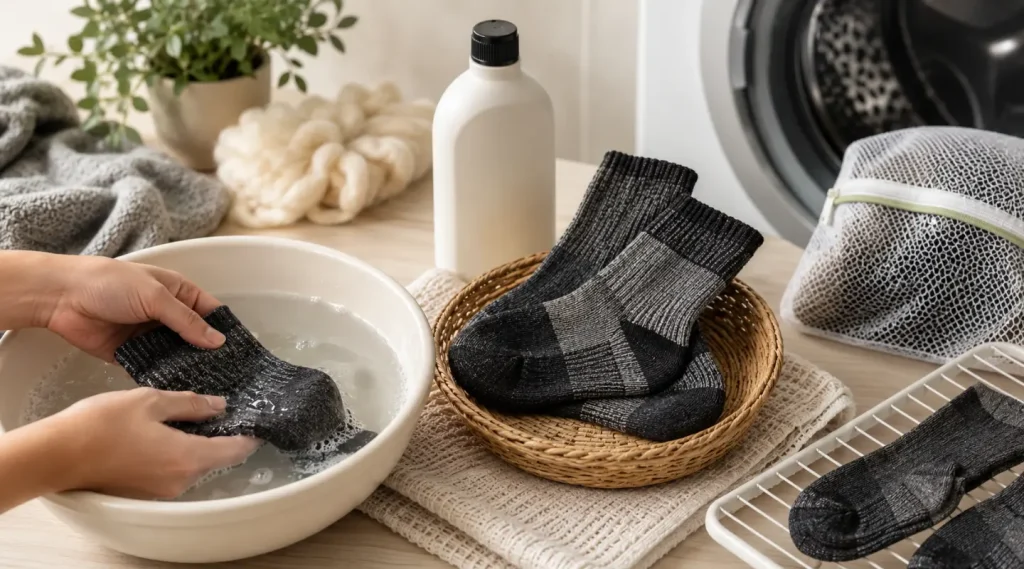
Hand washing eliminates all mechanical agitation risk and gives full temperature control, making it the safest method for high-quality merino. Each additional hand-wash cycle depletes less lanolin than machine washing, extending the sock’s odor resistance and moisture-wicking function longer across its lifespan.
Step 1 — Fill a basin with lukewarm water, maximum 30°C. Test temperature on the inside of your wrist, not your palm. Water that feels neutral on the wrist is approximately 30–35°C. If it feels noticeably warm, it is already too hot for merino.
Step 2 — Add 1 teaspoon of pH-neutral wool wash detergent (pH 6–9). Standard laundry detergents at pH 10–12 strip lanolin from wool fiber in a single wash. Stripped lanolin cannot be replaced, the sock permanently loses odor resistance and moisture-wicking function. Wool-specific detergents at pH 6–9 clean without stripping the fiber’s protective wax coating, according to the American Cleaning Institute’s detergent pH data.
Standard laundry detergents at pH 10–12 strip lanolin from wool fiber in a single wash cycle. Once lanolin is stripped, the sock loses its natural odor resistance and moisture-wicking function permanently. Wool-specific detergents at pH 6–9 preserve lanolin, which is why Pournara recommends this approach for their ART 360 100% German Merino Wool Socks to maintain full performance across dozens of washes.
Step 3 — Submerge socks and press gently downward. No rubbing, twisting, or scrubbing. Mechanical friction on wet merino fiber causes the same scale interlocking as heat agitation.
Step 4 — Soak for 5–10 minutes. Do not exceed 15 minutes. Prolonged submersion in water weakens the fiber’s hydrogen bonds, reducing elasticity over time.
Step 5 — Rinse twice in water at the same temperature. Temperature changes between wash and rinse water cause rapid fiber contraction. Use water matched to the wash basin temperature, not cold tap water.
Step 6 — Press water out gently between flat palms. Never wring or twist. Wringing twists fiber scales against each other and causes mechanical felting even in cold water.
Step 7 — Roll the sock inside a clean dry towel and press firmly. Rolling absorbs 60–70% of remaining moisture without mechanical stress on the fiber.
Step 8 — Lay flat to dry on a clean surface. Hanging wet merino causes gravity to stretch fibers lengthwise permanently. Flat drying preserves the original shape and dimensions.
Safe detergent pH is 6–9. Safe drying is flat at room temperature or tumble dry on low heat for a maximum of 30 minutes. These are not preferences, they are the two variables that most permanently damage merino outside of water temperature.
Standard laundry detergents at pH 10–12 strip lanolin from merino fiber on first contact. Fabric softeners cause a different but equally permanent problem: they coat fiber scales with a silicone or cationic layer that physically blocks the moisture transport channels in the fiber structure. After one fabric softener application, merino’s wicking function is reduced and does not recover with rinsing. Enzyme-based stain removers dissolve keratin protein directly, they are designed to break down protein stains, which means they also degrade the fiber itself.
Safe detergents: Woolite Gentle Cycle (pH ~7), Eucalan Wool Wash (pH ~7), Sonett Wool Wash (pH ~7.5), or any product labeled “pH neutral,” “lanolin-safe,” or “suitable for wool and silk.”
Unsafe products: Standard laundry detergent (pH 10–12), bleach (destroys keratin immediately), enzyme-based stain removers (degrades protein fiber), fabric softener (blocks moisture transport permanently).
Tumble drying on high heat felts merino in under 20 minutes according to Woolmark fiber care research. Low heat tumble drying is acceptable for a maximum of 30 minutes, check at 15 minutes. A practical test: if you feel heat through the dryer door glass with the back of your hand, the drum temperature is above 40°C and too hot for merino. Flat drying at room temperature takes 4–8 hours depending on sock thickness and is the only method with zero heat risk.
For readers who find the care requirements of premium merino demanding for everyday rotation, Pournara’s ART 205 German Lamb Wool Isothermal Socks and ART 604 German Lamb Wool Isothermal Socks offer isothermal lamb wool construction that tolerates washing more robustly than ultra-fine merino while maintaining temperature regulation.
Wash every 2–3 wears for everyday use. Athletes or readers with sweaty feet should wash every 1–2 wears. Each wash cycle removes some lanolin even with correct detergent, frequency directly determines how long the sock retains its natural odor resistance and moisture performance.
Cotton and synthetic socks need washing after every wear because they have no natural antimicrobial mechanism. Merino’s lanolin inhibits bacterial growth between wears, and keratin binds odor molecules until washing. A merino sock that smells clean after two wears does not need washing on day three, unnecessary washing accelerates lanolin depletion without benefit, according to CSIRO wool fiber research.
Storage: Roll loosely rather than folding tightly. Tight folds create crease points where fiber experiences repeated stress with each wear, accelerating hole formation at the fold line.
Pilling: Light surface pilling after 5–10 washes is normal and indicates active fiber movement, not damage. Remove with a fabric shaver rather than picking, which pulls and weakens fiber roots.
Odor between washes: Air socks flat overnight after wearing. Lanolin dissipates mild odor through exposure to air without requiring a full wash cycle.
End of lifespan signals: Fiber holes at high-wear points (heel, ball, toe), permanent felting that does not relax after washing, or loss of elasticity after 50–80 washes indicates the sock has reached the end of useful life.
For readers wondering whether merino’s care requirements are worth it for year-round wear, when merino wool socks are worth wearing in warm weather covers seasonal performance in detail.
For readers in Illinois rotating wool socks across cold winters and humid summers, 100% merino with German wool sourcing and seamless construction holds up longest across repeated correct-temperature washes. Pournara’s wool socks are crafted in Greece with over 75 years of hosiery expertise, using German lamb wool and 100% merino, starting at $14 with free shipping over $75, shoppournara.com/product-category/men/wool-mens-socks/.
A: Yes, with three conditions met: water temperature under 30°C, spin speed under 600 RPM, and a wool or delicate cycle selected. Standard warm cycles at 40°C or higher break keratin disulfide bonds in a single wash, causing permanent felting. Front-loading machines are safer than top-loaders with a central agitator.
A: Maximum 30°C (86°F) for both machine and hand washing. Above this threshold, keratin disulfide bonds in the wool fiber break under heat combined with agitation. Fiber scales interlock permanently, this is felting and cannot be undone. Most machine “cold” settings deliver 15–20°C, which is safely below the damage threshold.
A: Water above 30°C, combined with mechanical agitation, broke the keratin bonds in the fiber. The fiber scales interlocked permanently, a process called felting. High-spin cycles above 600 RPM cause the same result even in cold water. Once felted, the sock cannot be restored to original size or texture.
A: Use detergent with a pH between 6 and 9, labeled “wool-safe,” “pH neutral,” or “suitable for wool and silk.” Standard laundry detergents at pH 10–12 strip lanolin from the fiber in a single wash cycle, permanently removing the sock’s odor resistance and moisture-wicking function. Avoid fabric softener and enzyme-based stain removers.
A: Only on low heat for a maximum of 30 minutes. High heat tumble drying felts merino in under 20 minutes. Check at 15 minutes, if you feel heat through the door glass with the back of your hand, the drum temperature is already above 40°C and too hot. Flat drying at room temperature for 4–8 hours carries zero heat risk.
A: Every 2–3 wears for most users. Merino’s lanolin inhibits bacterial growth and keratin binds odor molecules between washes, daily washing is unnecessary and accelerates lanolin depletion. Athletes or people with sweaty feet should wash every 1–2 wears. If the sock smells clean after two wears, a third wear before washing is appropriate.
A: Not fully. Felting is the permanent interlocking of fiber scales caused by heat above 30°C or mechanical agitation above 600 RPM. Some partial size recovery is possible by soaking in lukewarm water with a small amount of hair conditioner and gently stretching while wet, but fiber scale interlocking cannot be fully reversed.
A: Yes. Pournara’s ART 360 100% German Merino Wool Socks are machine washable at under 30°C on a gentle cycle with spin speed below 600 RPM. German lamb wool isothermal options (ART 205 and ART 604) follow the same care requirements. All Pournara wool socks ship nationally from Illinois with free shipping over $75. Visit shoppournara.com for full care details.
Looking for German merino wool socks built to last through dozens of correct wash cycles?
Pournara’s wool socks start at $14, crafted in Greece with free shipping over $75.
shoppournara.com/product-category/men/wool-mens-socks/