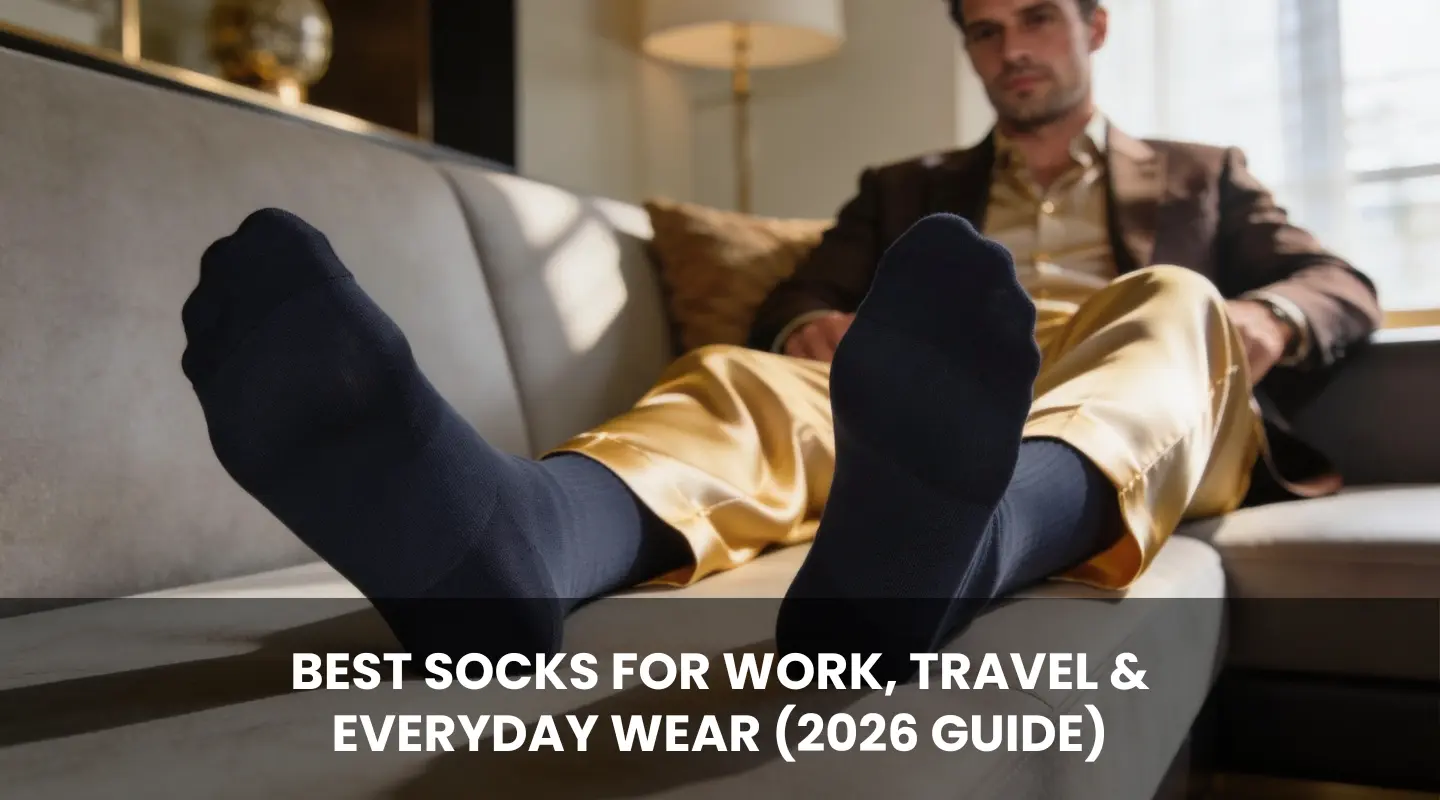
Most men think any sock will do. Grab a pair from the drawer, pull them on, move on. And then, halfway through a 10-hour workday or a transatlantic flight, you’re thinking about your feet constantly, for all the wrong reasons.
The right sock doesn’t demand your attention. That’s the whole point. But getting there requires knowing which material, construction, and style fits which context. Work socks, travel socks, and everyday socks have different demands. Confusing them costs you comfort.
This guide breaks down the best socks for each of those 3 situations, what to look for, and where Pournara’s Greek-made collections fit into the picture.
The right sock reduces blisters, regulates temperature, controls odor, and prevents fatigue during long periods on your feet. The wrong one does the opposite. On a 10-hour work shift or a long-haul flight, a poor-fitting sock with no moisture management becomes a genuine problem, not just a minor inconvenience.
Foot comfort is directly connected to posture and energy levels. A sock that bunches, slips, or holds moisture transfers pressure unevenly across the foot. That contributes to foot fatigue, which compounds over the course of a full day. Choosing the right material and construction from the start removes that problem entirely.
The 5 most important factors in a quality men’s sock are material composition, cushioning level, moisture management, cuff grip, and durability at high-wear zones.
The 5 most commonly used natural and technical materials in quality men’s socks are mercerized cotton, Egyptian cotton, bamboo, merino wool, and silk. Each performs differently depending on the setting:
Light cushioning works best in dress shoes and Oxfords, where sock thickness affects fit inside a closed toe. Medium cushioning suits casual shoes, loafers, and everyday sneakers. Heavy cushioning belongs in work boots and hiking footwear, not business settings. A sock with too much cushion inside a slim dress shoe creates pressure and reduces circulation.
Very important. The average man’s foot contains around 250,000 sweat glands. During an 8-hour workday, feet generate significant moisture. Socks that absorb moisture without releasing it create the conditions for blisters, odor, and bacterial growth. Wicking fibers, including bamboo and mercerized cotton, draw moisture away from the skin surface and allow evaporation.
A well-constructed cuff with elastane wrapping holds the sock in place without cutting into the calf. Look for socks with a rib-knit cuff structure. High-quality options from manufacturers like Pournara use non-restrictive cuff designs that grip the leg without leaving marks or slipping during movement.
The heel and toe. These are the highest-friction zones during daily wear. Socks without reinforced construction at both points develop holes and thin patches within months. Quality socks, particularly those knitted on 200-needle machines and above, reinforce these zones as standard.
The best socks for work combine a slim profile to fit dress shoes cleanly, moisture control for all-day wear, professional appearance, and a cuff that holds its position through long hours at a desk or on your feet.
A work sock needs 4 things: a thin enough profile to sit inside dress shoes without bulk, odor and moisture control for 8 to 10 hours of continuous wear, color and construction appropriate for business dress, and a cuff that doesn’t slip. Volume matters in dress settings. A thick casual sock inside a leather Oxford creates pressure and affects circulation.
Mercerized cotton is the most reliable material for professional office settings. The mercerization process strengthens the cotton fiber, adds a subtle sheen, and improves color absorption so socks maintain their appearance wash after wash. For high-pressure formal meetings, silk is the correct choice. For a business casual environment, bamboo provides comfort and antibacterial performance without the maintenance demands of silk.
Pournara produces 3 collections suited to professional work environments:
All 3 are manufactured in Athens on 220-needle machines, which produces a finer and more uniform knit than most standard dress socks. Free shipping on orders over $75.
The best travel socks manage odor over extended hours, resist moisture buildup during long flights or transit days, pack light, and support circulation during prolonged periods of sitting.
Travel puts 3 specific demands on socks that everyday wear doesn’t. First, long-haul flights create circulation issues in the lower legs: reduced movement and cabin pressure slow blood flow, which causes swelling. Second, extended days involving multiple environments, airports, hotels, city walking, require a sock that transitions between conditions without becoming uncomfortable. Third, travel limits access to laundry, so a sock’s antibacterial and odor-resistant properties matter more than usual.
Bamboo is the strongest all-around choice for travel socks. The fiber is naturally antibacterial, moisture-wicking, and faster-drying than cotton. Compression options are worth considering for flights over 4 hours. Graduated compression socks at 15 to 20 mmHg support blood flow during extended periods of sitting and reduce the swelling that accumulates in the lower leg during long-haul travel.
For men who travel light and repack between locations, bamboo’s quick-dry properties are practical. A bamboo sock washed in a hotel sink dries overnight. Standard cotton does not.
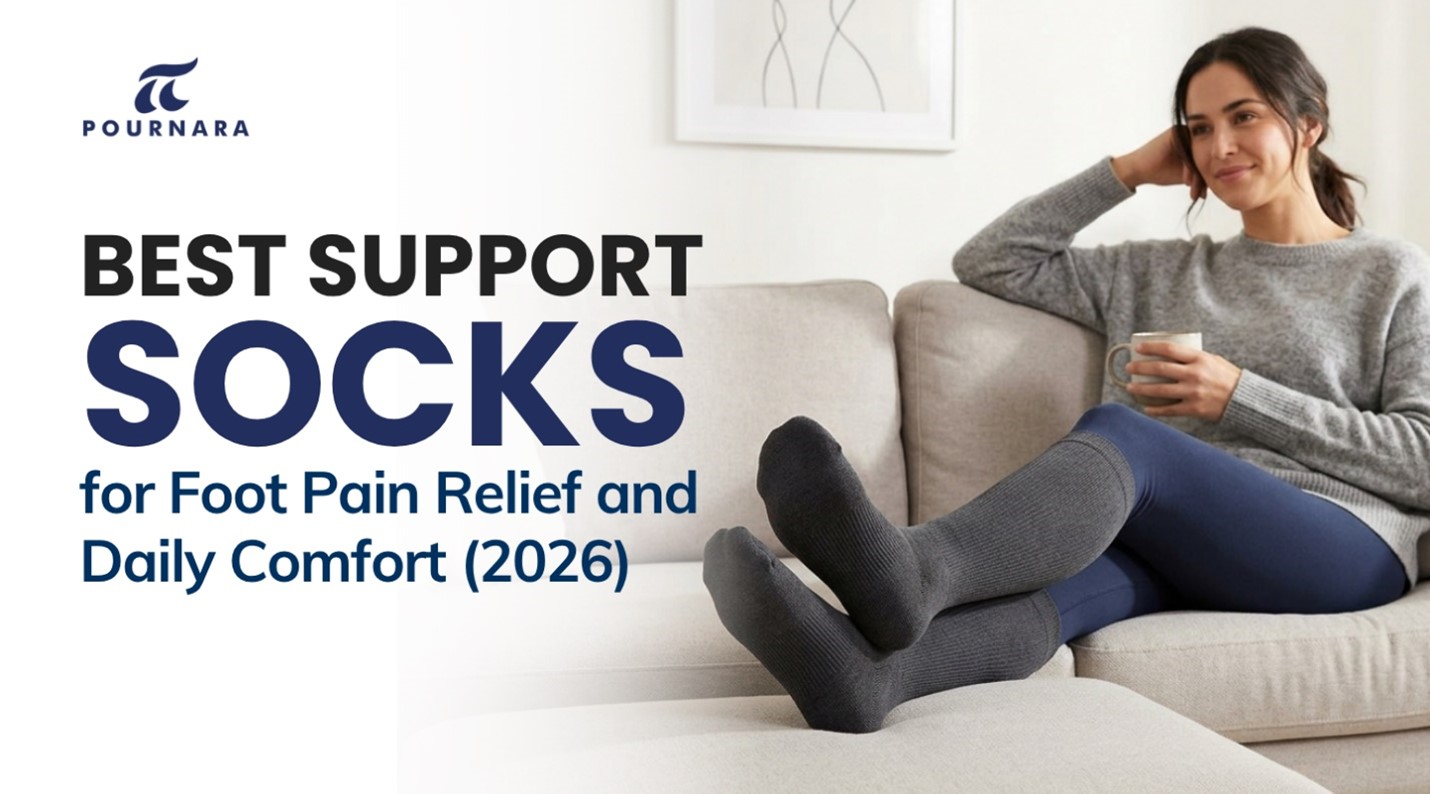
Also read this article, Best Support Socks for Foot Pain Relief and Daily Comfort.
A good travel sock has 5 features:
2 Pournara collections suit travel-specific conditions:
Both are made with 100% natural fibers, manufactured in Athens under Pournara’s quality standards that date to 1949.
The best everyday socks balance all-day comfort, versatility across casual and semi-formal outfits, enough durability to last through regular washing, and enough visual range to work with multiple shoe types and clothing styles.
An everyday sock is worn more often than any other type. It needs to hold its shape across dozens of washes, fit comfortably in multiple shoe styles, resist odor during normal daily activity, and look clean enough for both casual and smart-casual settings. It’s the workhorse of the sock drawer. Durability matters more here than in formal or travel contexts.
Mercerized cotton and bamboo are the 2 strongest everyday materials. Mercerized cotton handles frequent washing without losing shape or color. Bamboo maintains its antibacterial properties over time and suits men with sensitive skin. For personality and styling variety, fashion-oriented socks in bold colors and patterns add something to an everyday casual outfit without requiring a material change.
Pournara’s everyday range covers 3 distinct preferences:
The table below summarizes how sock requirements differ across the 3 use cases covered in this guide.
| Work | Travel | Everyday | |
| Best Material | Mercerized cotton / Silk | Bamboo / Compression | Mercerized cotton / Bamboo |
| Cushion Level | Light | Light to moderate | Light to medium |
| Cuff Style | Non-restrictive rib | Non-slip grip | Standard rib |
| Most Important Feature | Professional appearance | Antibacterial / Odor resistance | Durability / Versatility |
| Pournara Pick | Business or Silk Collection | Bamboo or Medical Collection | Classic or Anesis Collection |
The most common mistake men make is using one sock type for all 3 situations. A heavy casual sock inside a dress shoe is uncomfortable and visually wrong. A standard business cotton sock worn on a 12-hour travel day becomes saturated and odorous by hour 6. Matching socks to context costs nothing extra if you’re already building a small, intentional rotation.
6 practical rules for building a sock rotation that covers work, travel, and everyday wear:
The closest thing to a universal sock is a high-quality mercerized cotton sock from a construction-focused manufacturer. It’s professional enough for business casual settings, comfortable enough for daily wear, and durable enough for travel. It won’t replace a compression sock on a 14-hour flight or a silk sock at a black-tie event. But for the 80% of days that fall between those extremes, it handles the brief.
Pournara’s Anesis and Classic collections were built for exactly that: daily versatility with the quality standards of a specialist sock. Knitted in Athens from 100% mercerized cotton, they’re the foundation of a well-organized men’s sock drawer.
Mercerized cotton socks are best for standard office and business casual settings. They have a professional appearance, control moisture effectively during long workdays, and hold their color and shape across repeated washes. For formal or executive settings, silk is the superior choice. For standing-heavy environments, look for light cushioning with reinforced heel and toe.
Mercerized cotton works for shorter travel days. For flights over 4 hours or multi-day trips, bamboo is a better choice. Bamboo dries faster, resists odor longer, and stays fresher over extended wear. For long-haul flights specifically, graduated compression socks between 15 and 20 mmHg provide circulation support that neither cotton nor bamboo offers on their own.
Pack 1 pair per day plus 1 extra. If you’re traveling for 5 days, pack 6 pairs. Never rewear a travel sock without washing it first. Antibacterial fibers reduce odor but don’t reset hygiene. For short trips to locations with hotel laundry access, bamboo’s quick-dry property lets you wash and reuse a pair within 24 hours.
Mercerized cotton socks in neutral colors work across both contexts. Black, navy, charcoal, and mid-grey cover professional settings cleanly. The same colors work with casual trousers, chinos, and smart jeans without looking out of place. Pournara’s Classic and Anesis collections are built around exactly this dual-use brief.
Yes. Graduated compression socks at 15 to 20 mmHg support venous blood flow during extended periods of sitting. Long-haul flights reduce movement and lower cabin pressure, which slows circulation in the lower legs and causes swelling. Compression socks counter that effect. They’re not a replacement for moving around the cabin periodically, but they’re a meaningful addition to any flight over 4 hours.
Pournara
We firmly believe that the internet should be available and accessible to anyone, and are committed to providing a website that is accessible to the widest possible audience, regardless of circumstance and ability.
To fulfill this, we aim to adhere as strictly as possible to the World Wide Web Consortium’s (W3C) Web Content Accessibility Guidelines 2.1 (WCAG 2.1) at the AA level. These guidelines explain how to make web content accessible to people with a wide array of disabilities. Complying with those guidelines helps us ensure that the website is accessible to all people: blind people, people with motor impairments, visual impairment, cognitive disabilities, and more.
This website utilizes various technologies that are meant to make it as accessible as possible at all times. We utilize an accessibility interface that allows persons with specific disabilities to adjust the website’s UI (user interface) and design it to their personal needs.
Additionally, the website utilizes an AI-based application that runs in the background and optimizes its accessibility level constantly. This application remediates the website’s HTML, adapts Its functionality and behavior for screen-readers used by the blind users, and for keyboard functions used by individuals with motor impairments.
If you’ve found a malfunction or have ideas for improvement, we’ll be happy to hear from you. You can reach out to the website’s operators by using the following email
Our website implements the ARIA attributes (Accessible Rich Internet Applications) technique, alongside various different behavioral changes, to ensure blind users visiting with screen-readers are able to read, comprehend, and enjoy the website’s functions. As soon as a user with a screen-reader enters your site, they immediately receive a prompt to enter the Screen-Reader Profile so they can browse and operate your site effectively. Here’s how our website covers some of the most important screen-reader requirements, alongside console screenshots of code examples:
Screen-reader optimization: we run a background process that learns the website’s components from top to bottom, to ensure ongoing compliance even when updating the website. In this process, we provide screen-readers with meaningful data using the ARIA set of attributes. For example, we provide accurate form labels; descriptions for actionable icons (social media icons, search icons, cart icons, etc.); validation guidance for form inputs; element roles such as buttons, menus, modal dialogues (popups), and others. Additionally, the background process scans all the website’s images and provides an accurate and meaningful image-object-recognition-based description as an ALT (alternate text) tag for images that are not described. It will also extract texts that are embedded within the image, using an OCR (optical character recognition) technology. To turn on screen-reader adjustments at any time, users need only to press the Alt+1 keyboard combination. Screen-reader users also get automatic announcements to turn the Screen-reader mode on as soon as they enter the website.
These adjustments are compatible with all popular screen readers, including JAWS and NVDA.
Keyboard navigation optimization: The background process also adjusts the website’s HTML, and adds various behaviors using JavaScript code to make the website operable by the keyboard. This includes the ability to navigate the website using the Tab and Shift+Tab keys, operate dropdowns with the arrow keys, close them with Esc, trigger buttons and links using the Enter key, navigate between radio and checkbox elements using the arrow keys, and fill them in with the Spacebar or Enter key.Additionally, keyboard users will find quick-navigation and content-skip menus, available at any time by clicking Alt+1, or as the first elements of the site while navigating with the keyboard. The background process also handles triggered popups by moving the keyboard focus towards them as soon as they appear, and not allow the focus drift outside it.
Users can also use shortcuts such as “M” (menus), “H” (headings), “F” (forms), “B” (buttons), and “G” (graphics) to jump to specific elements.
We aim to support the widest array of browsers and assistive technologies as possible, so our users can choose the best fitting tools for them, with as few limitations as possible. Therefore, we have worked very hard to be able to support all major systems that comprise over 95% of the user market share including Google Chrome, Mozilla Firefox, Apple Safari, Opera and Microsoft Edge, JAWS and NVDA (screen readers).
Despite our very best efforts to allow anybody to adjust the website to their needs. There may still be pages or sections that are not fully accessible, are in the process of becoming accessible, or are lacking an adequate technological solution to make them accessible. Still, we are continually improving our accessibility, adding, updating and improving its options and features, and developing and adopting new technologies. All this is meant to reach the optimal level of accessibility, following technological advancements. For any assistance, please reach out to