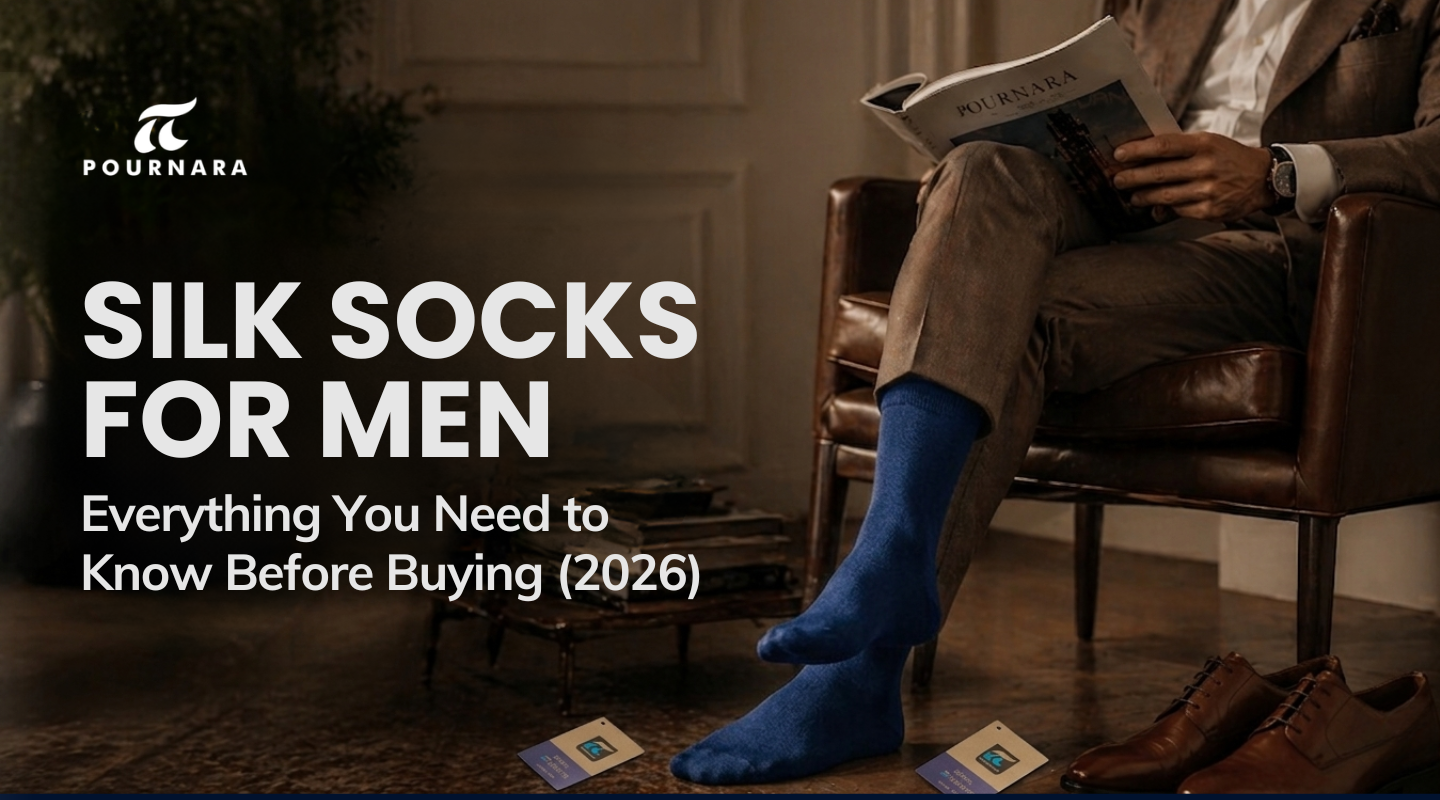
Most men spend real money on shoes and almost nothing on what goes inside them. Socks are an afterthought. And silk socks? For most guys, they sit somewhere between “vaguely interested” and “probably not worth it.”
They’re worth it. But only if you buy the right pair.
This guide covers what silk socks are made from, why they perform differently than cotton or bamboo, when to wear them, how to keep them in good shape, and what to look for before spending your money.
Silk socks are hosiery knitted from natural silk fiber, produced by Bombyx mori silkworms. Once harvested, the raw fiber is cleaned, carded, and spun into a lustrous yarn that is finer and smoother than any other natural material commonly used in dress hosiery.
Silk in menswear is not new. Chinese aristocrats used silk foot coverings as early as 1000 BC. European nobility adopted silk stockings in the 16th century as a visible marker of social rank. Today, silk socks sit at the top of the dress hosiery hierarchy, valued for their sheen, negligible weight, and year-round temperature performance.
The 3 most common silk sock constructions are:
Silk socks for men are defined by 5 primary features: natural fiber composition, ultra-fine texture, lightweight construction, a distinctive natural sheen, and temperature regulation across both warm and cold conditions.
Quality silk socks contain at least 60% silk fiber. Blends below that threshold lose the hand-feel and sheen that make the material worth the price. Pure silk socks (90% and above) deliver the most luxurious feel but require careful cold-water washing to maintain fiber integrity.
Silk fiber has a smooth, slightly cool initial touch. There is no scratchiness, no friction, no irritation. For men who find cotton or wool dress socks uncomfortable inside tighter leather dress shoes, silk changes the experience entirely. The fiber conforms to the shape of the foot rather than rubbing against it.
Silk is lighter than cotton, bamboo, and wool socks. A standard silk dress sock weighs between 20 and 30 grams per pair. That barely-there feel inside an Oxford or loafer is central to the appeal. No bunching, no visible bulk, no thickness under the trouser break.
Silk fiber is triangular in cross-section. That geometric shape reflects light from multiple angles simultaneously, producing the characteristic luminous sheen visible under natural or office lighting. No synthetic material replicates this optical property accurately. Under good light, silk socks catch and return light in a way that immediately separates them from every other dress sock material.
The 5 main benefits of silk socks for men are temperature regulation, moisture wicking, hypoallergenic properties, natural odor resistance, and long-term durability when maintained correctly.
Yes. Silk has a hollow fiber structure that traps warm air in cold conditions and releases excess heat when temperatures rise. This makes silk socks effective across all four seasons, not just formal winter occasions. Men who wear them in summer report cooler feet than in standard cotton, while winter wearers find them genuinely insulating inside leather dress shoes.
Silk absorbs up to 30% of its own weight in moisture without feeling wet against the skin. The fiber draws perspiration away from the foot surface and releases it through evaporation. Feet stay dry through a full working day without the clammy buildup that synthetic blends produce by mid-afternoon.
Yes. Silk is a protein-based fiber that contains no synthetic chemicals or irritants in its natural form. Men with sensitive skin, eczema, or reactions to wool and synthetic blends consistently report fewer issues with silk. It is one of the gentlest fibers in dress hosiery, and it’s a strong choice for anyone whose skin is reactive to standard cotton blends treated with finishing chemicals.
Silk has natural antibacterial properties that inhibit odor-producing bacteria. Combined with its moisture-wicking behavior, silk keeps socks fresher between washes. Less moisture retained against the skin means less bacterial activity, which translates directly to less odor over the course of a long day.
Well-maintained silk socks last 2 to 4 years with regular rotation. Silk fiber is strong for its weight, but heat and harsh detergents degrade it quickly. Cold-water hand washing, mild detergent, and flat drying are the non-negotiables. Do those 3 things consistently, and a quality silk sock outlasts many cotton alternatives replaced every few months.
The table below compares silk socks against 3 other common dress sock materials across 5 performance categories.
| Silk | Mercerized Cotton | Bamboo | Merino Wool | |
| Softness | Excellent | Very Good | Very Good | Good |
| Breathability | Excellent | Good | Very Good | Excellent |
| Moisture Wicking | Very Good | Moderate | Very Good | Excellent |
| Sheen and Appearance | Excellent | Good | Low | Low |
| Best Occasion | Formal / Business | Office / Everyday | Everyday / Travel | Cold / Outdoor |
Silk leads on appearance and all-season comfort. Merino wool outperforms it during high-sweat activity. For formal and business dress, no natural fiber produces a comparable visual result. Pournara’s mercerized cotton socks and bamboo collection are strong alternatives for everyday wear, but for the occasion that calls for polish, silk is the correct answer.
Silk socks are best suited to 4 categories of occasion: formal events, professional business settings, office wear with leather dress shoes, and evening social occasions. They are not designed for athletic use or casual sneaker pairings.
The 4 occasions where silk socks are the right choice:
Oxford shoes, Derby shoes, loafers, and leather brogues all work well with silk socks. The slim profile of silk fits inside close-fitting leather dress shoes without creating bulk or pressure. Avoid pairing silk socks with sneakers, sports shoes, or Chelsea boots in casual settings. The fiber is not engineered for high-friction, high-movement activity.
The standard guideline: match the sock to the trouser, not the shoe. A dark navy suit calls for navy or charcoal silk. Light grey trousers work with steel grey or ivory. If wearing a patterned silk sock, pull one color from the sock’s design and echo it in another element of the outfit: a tie, a pocket square, or a lapel pin.
3 reliable silk sock color combinations for men:
Hand wash silk socks in cold water with a mild, pH-neutral detergent. Never use bleach, hot water, or a tumble dryer. Press gently to remove excess water, then lay flat to air dry away from direct sunlight and heat sources.
Step-by-step care routine:
One hot machine wash can permanently damage silk fiber. Temperature control is the single most important care habit. Get that right and the rest follows naturally.
When buying silk socks, check 5 things before purchasing: silk fiber percentage, needle count, construction at the heel and toe, cuff design, and country of manufacture.
Silk socks are worth buying for men who wear dress shoes regularly, attend formal occasions, or want a sock that performs confidently in all seasons without compromise. The price per pair is higher than cotton. Measured by cost-per-wear, a quality silk sock maintained correctly costs no more than a cheaper alternative replaced twice a year.
The difference is what you get for that cost. Temperature regulation that cotton doesn’t match. A natural sheen that no synthetic replicates. A fit so light inside a dress shoe you forget you’re wearing anything at all.
Pournara’s silk socks for men are knitted in Athens from premium natural silk fiber, on 220-needle machines, by a brand that has been producing Greek hosiery since 1949. They’re designed for men who know that what you can’t immediately see still matters.
Yes. Silk socks are worth it for men who dress for professional or formal settings regularly. They offer temperature regulation, moisture management, hypoallergenic properties, and a natural sheen that no other sock material replicates. With correct care, a quality pair lasts 2 to 4 years.
Hand wash in cold water with a mild, pH-neutral detergent. Do not use bleach, hot water, or a tumble dryer. Rinse with cool water, press gently to remove moisture, and lay flat to air dry away from heat. Temperature is the critical factor. Heat degrades silk fiber faster than any other cause.
Yes, with proper rotation. Daily wear is sustainable as long as each pair rests between uses. A rotation of 3 to 4 pairs means no single sock is worn more than twice a week, which significantly extends fiber lifespan and keeps the collection in better shape longer.
Silk socks have a natural sheen, better temperature regulation, and a lighter, smoother feel than cotton. Cotton socks are more resistant to abrasion and easier to launder. Mercerized cotton adds sheen and strength to standard cotton but doesn’t replicate silk’s thermoregulating properties or its drape inside a dress shoe.
Pournara
We firmly believe that the internet should be available and accessible to anyone, and are committed to providing a website that is accessible to the widest possible audience, regardless of circumstance and ability.
To fulfill this, we aim to adhere as strictly as possible to the World Wide Web Consortium’s (W3C) Web Content Accessibility Guidelines 2.1 (WCAG 2.1) at the AA level. These guidelines explain how to make web content accessible to people with a wide array of disabilities. Complying with those guidelines helps us ensure that the website is accessible to all people: blind people, people with motor impairments, visual impairment, cognitive disabilities, and more.
This website utilizes various technologies that are meant to make it as accessible as possible at all times. We utilize an accessibility interface that allows persons with specific disabilities to adjust the website’s UI (user interface) and design it to their personal needs.
Additionally, the website utilizes an AI-based application that runs in the background and optimizes its accessibility level constantly. This application remediates the website’s HTML, adapts Its functionality and behavior for screen-readers used by the blind users, and for keyboard functions used by individuals with motor impairments.
If you’ve found a malfunction or have ideas for improvement, we’ll be happy to hear from you. You can reach out to the website’s operators by using the following email
Our website implements the ARIA attributes (Accessible Rich Internet Applications) technique, alongside various different behavioral changes, to ensure blind users visiting with screen-readers are able to read, comprehend, and enjoy the website’s functions. As soon as a user with a screen-reader enters your site, they immediately receive a prompt to enter the Screen-Reader Profile so they can browse and operate your site effectively. Here’s how our website covers some of the most important screen-reader requirements, alongside console screenshots of code examples:
Screen-reader optimization: we run a background process that learns the website’s components from top to bottom, to ensure ongoing compliance even when updating the website. In this process, we provide screen-readers with meaningful data using the ARIA set of attributes. For example, we provide accurate form labels; descriptions for actionable icons (social media icons, search icons, cart icons, etc.); validation guidance for form inputs; element roles such as buttons, menus, modal dialogues (popups), and others. Additionally, the background process scans all the website’s images and provides an accurate and meaningful image-object-recognition-based description as an ALT (alternate text) tag for images that are not described. It will also extract texts that are embedded within the image, using an OCR (optical character recognition) technology. To turn on screen-reader adjustments at any time, users need only to press the Alt+1 keyboard combination. Screen-reader users also get automatic announcements to turn the Screen-reader mode on as soon as they enter the website.
These adjustments are compatible with all popular screen readers, including JAWS and NVDA.
Keyboard navigation optimization: The background process also adjusts the website’s HTML, and adds various behaviors using JavaScript code to make the website operable by the keyboard. This includes the ability to navigate the website using the Tab and Shift+Tab keys, operate dropdowns with the arrow keys, close them with Esc, trigger buttons and links using the Enter key, navigate between radio and checkbox elements using the arrow keys, and fill them in with the Spacebar or Enter key.Additionally, keyboard users will find quick-navigation and content-skip menus, available at any time by clicking Alt+1, or as the first elements of the site while navigating with the keyboard. The background process also handles triggered popups by moving the keyboard focus towards them as soon as they appear, and not allow the focus drift outside it.
Users can also use shortcuts such as “M” (menus), “H” (headings), “F” (forms), “B” (buttons), and “G” (graphics) to jump to specific elements.
We aim to support the widest array of browsers and assistive technologies as possible, so our users can choose the best fitting tools for them, with as few limitations as possible. Therefore, we have worked very hard to be able to support all major systems that comprise over 95% of the user market share including Google Chrome, Mozilla Firefox, Apple Safari, Opera and Microsoft Edge, JAWS and NVDA (screen readers).
Despite our very best efforts to allow anybody to adjust the website to their needs. There may still be pages or sections that are not fully accessible, are in the process of becoming accessible, or are lacking an adequate technological solution to make them accessible. Still, we are continually improving our accessibility, adding, updating and improving its options and features, and developing and adopting new technologies. All this is meant to reach the optimal level of accessibility, following technological advancements. For any assistance, please reach out to