If you are on your feet for eight, ten, or twelve hours a day, the socks you choose matter almost as much as the shoes. Nurses, teachers, retail associates, and other standing-heavy professionals put more strain on their feet in a single shift than most people do in a week, and the wrong sock can turn a long day into a painful one.
The best socks for standing all day are moisture-wicking, cushioned socks with arch support and seamless toe construction, made from merino wool or synthetic performance blends. Compression or graduated-compression styles are especially helpful for nurses, teachers, and retail workers on their feet for eight or more hours, since they support circulation, reduce end-of-day swelling, and help prevent blisters and hot spots during long shifts.
Standing for extended periods is a different kind of stress on the body than walking or sitting. When you stand still or move within a small area for hours, blood tends to pool in the lower legs, muscles fatigue from constant low-level tension, and pressure builds unevenly across the soles of the feet.
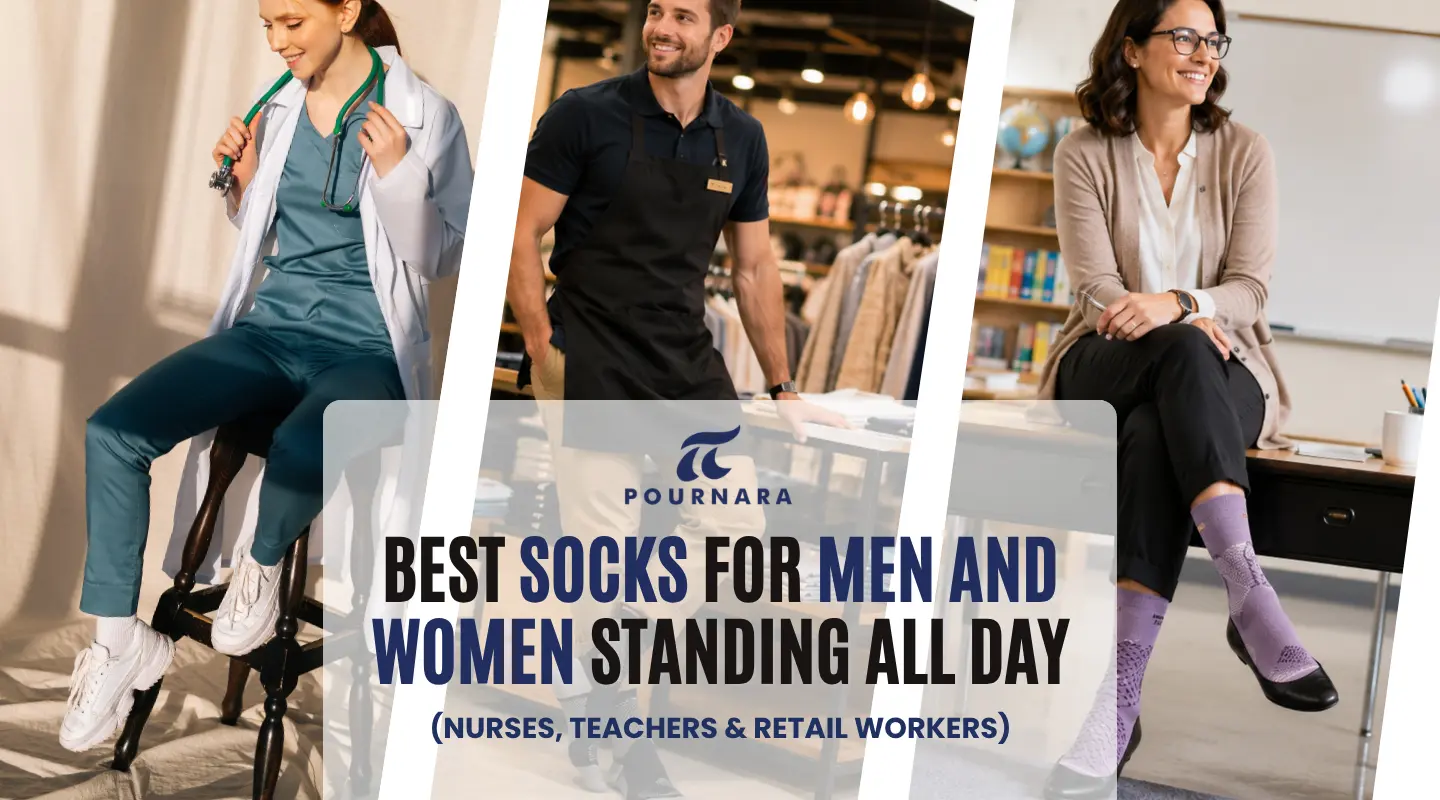
These three professions share a common thread: long hours upright, often on hard flooring, with limited breaks.
According to the U.S. Bureau of Labor Statistics, healthcare support occupations and retail sales positions are among the job categories with the highest rates of standing-related physical strain, reflecting how common these working conditions are across the country bls.gov.
The American Podiatric Medical Association notes that prolonged standing is a leading contributor to foot fatigue, plantar fasciitis, varicose veins, and lower back pain among working adults apma.org. Over time, unsupportive footwear and socks can compound these issues, leading to chronic discomfort that affects performance and quality of life both on and off the clock. If foot pain has already set in, our guide to the best support socks for foot pain relief walks through options built specifically for that kind of daily discomfort.
Not all socks are built for endurance. The right pair addresses four core needs: cushioning, moisture control, structural support, and breathability.
Look for socks with extra padding in the heel and ball of the foot, the two areas that absorb the most impact during standing and walking. Light to moderate graduated compression (roughly 15 to 20 mmHg for everyday wear) can also help push blood back toward the heart, reducing the heavy, swollen feeling many standing workers report by the end of a shift. If you’re new to compression sizing and mmHg levels, our Compression Socks Guide breaks down features, benefits, and how to pick the right strength.
Fabric choice affects comfort more than most people realize.
A built-in arch band helps stabilize the foot and reduce fatigue, while a seamless toe closure prevents the rubbing and irritation that can develop after hours of repetitive movement.
Ventilated knit zones, usually placed across the top of the foot, help air circulate and reduce sweat buildup, which matters just as much in a warm retail stockroom as it does on a busy hospital floor.
Men who stand for long shifts generally do best with crew or over-the-calf length socks that combine reinforced heel and toe cushioning with a supportive, non-slip fit. Look for a wider toe box for natural toe splay, moderate compression through the arch, and a fabric blend that manages both moisture and odor over a full workday. Sizing should account for shoe fit as well, since a sock that is too tight can restrict circulation and one that is too loose can bunch and cause blisters. Browse Pournara’s full men’s sock collection to compare cushioned, wool, and compression styles side by side.
Women who stand for extended periods often benefit from cushioned no-show or crew socks with a snug, contoured heel to prevent slipping inside the shoe, along with graduated compression options for shifts that regularly exceed eight hours. A moisture-wicking blend paired with a reinforced arch band helps address the pressure points that build up from standing on hard flooring in retail, healthcare, and classroom settings. As with men’s sizing, a proper fit through the ankle and instep is key to avoiding pinching or excess fabric that can rub during movement. Pournara’s women’s sock collection includes cushioned and compression styles designed with these pressure points in mind.
Yes, for most healthy adults, light to moderate compression socks can meaningfully reduce the leg fatigue and swelling associated with prolonged standing. Graduated compression works by applying more pressure at the ankle and gradually less pressure up the leg, which encourages blood flow back toward the heart rather than allowing it to pool.
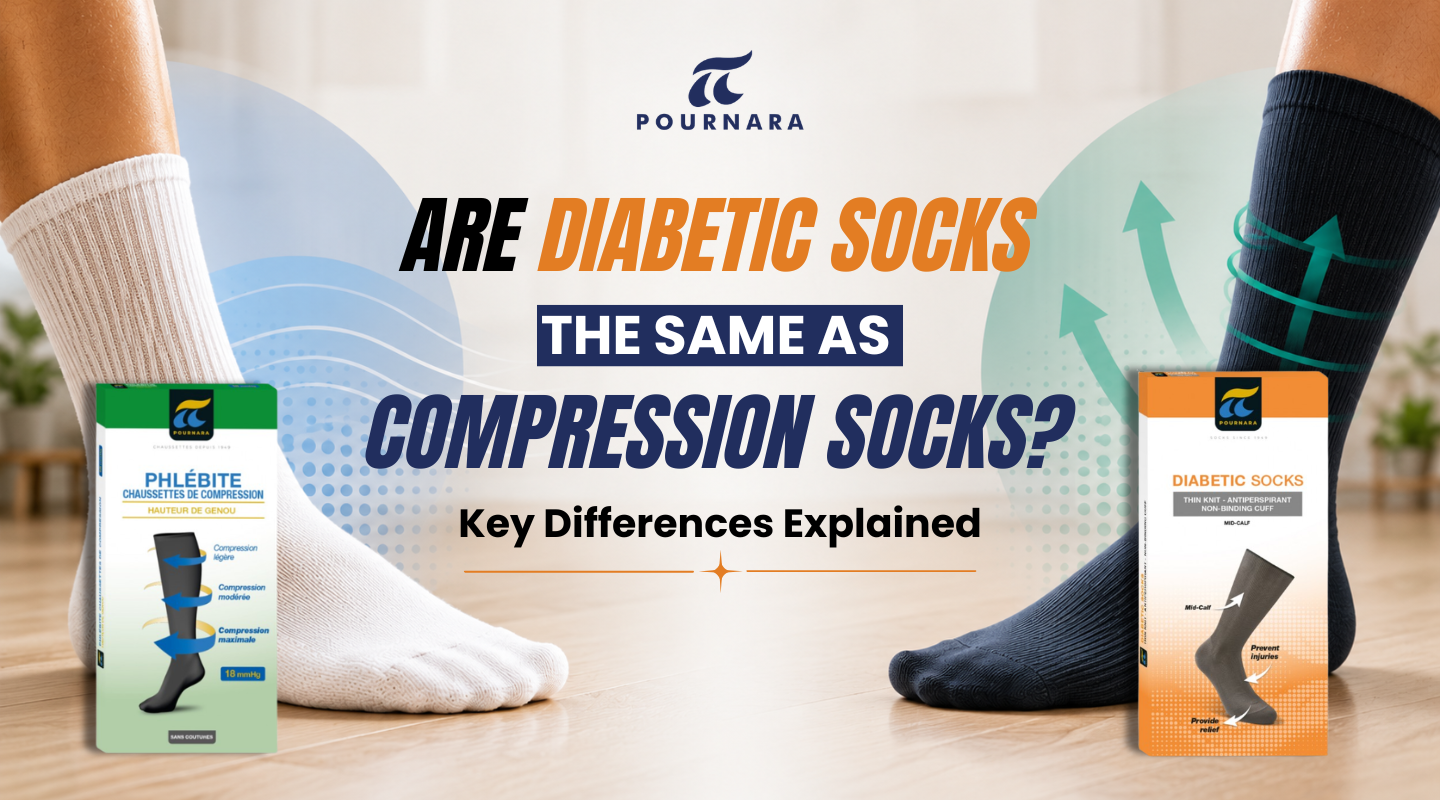
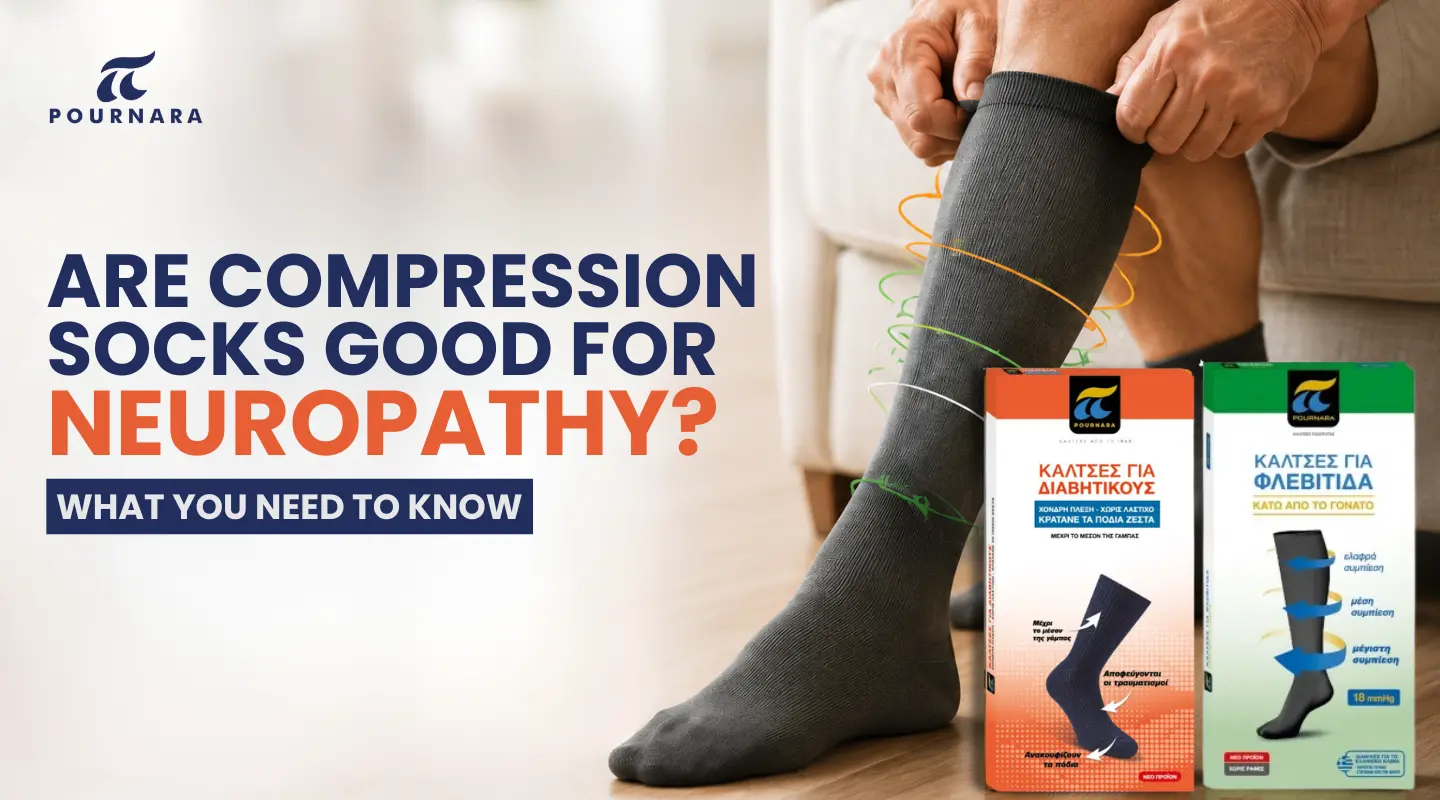
The Mayo Clinic notes that compression stockings are commonly recommended to help manage swelling and improve circulation in people who stand or sit for long periods, though it also advises that individuals with certain circulatory conditions, diabetes, or peripheral artery disease should consult a physician before wearing compression garments mayoclinic.org. This is a case where personalized medical guidance matters more than general advice, so if you have an existing health condition, check with your doctor before adding compression socks to your routine. If you’re managing nerve-related foot pain specifically, our article on whether compression socks help with neuropathy goes deeper on that use case, and if you’ve been told to look at diabetic socks, our comparison of diabetic vs. compression socks explains the key differences.
Prioritize moderate graduated compression, moisture-wicking synthetic or merino blends, and reinforced cushioning at the heel and ball of the foot. Antimicrobial fibers are a helpful bonus in clinical environments where hygiene is a constant concern. Pournara’s medical sock collection is built around exactly these needs for long clinical shifts.
Since teaching involves both standing and frequent short walks, a breathable crew sock with moderate cushioning and a secure, non-slip fit tends to work better than heavy compression, which some teachers find restrictive during more active parts of the day.
Retail environments call for maximum cushioning in the heel and forefoot, since concrete and tile flooring transmits more impact than carpet or cushioned mats. A durable synthetic blend that holds its shape wash after wash is especially valuable for employees working frequent back-to-back shifts. For more head-to-toe options built for this kind of day, see our roundup of the top 10 comfortable socks for long days on your feet.
Once you understand what your feet actually need, standing all day becomes far more manageable, and that is exactly the standard Pournara designs around. Pournara’s sock collection is built with cushioned support zones, moisture-wicking blends, and reinforced arch construction aimed at people who spend their workday on their feet, from nurses and teachers to retail associates. If you are ready to put the guidance above into practice, browse the full Pournara sock collection, including men’s all-day comfort styles and women’s compression and cushioned styles.
Nurses generally recommend moisture-wicking, moderately compressive socks with reinforced heel and toe cushioning. Merino wool or synthetic performance blends are popular choices because they manage sweat and reduce friction over long, physically demanding shifts.
For most healthy adults, yes. Light to moderate graduated compression can reduce swelling and improve circulation during long periods of standing. People with diabetes, peripheral artery disease, or other circulatory conditions should check with a doctor first.
Most cushioned or compression socks should be replaced every six to twelve months with regular wear, or sooner if you notice thinning cushioning, loose elastic, or reduced compression.
Cushioned socks add extra padding in high-impact areas like the heel and forefoot to absorb shock. Compression socks use graduated pressure to support circulation. Many all-day work socks combine both features.
Cotton absorbs and retains moisture rather than wicking it away, which can increase friction and the risk of blisters during long shifts. Moisture-wicking synthetic or merino wool blends generally perform better for all-day standing.
A properly fitted sock should feel snug through the arch and ankle without pinching, with no excess fabric bunching at the toe or heel. Sizing should be matched to your shoe size, not just your shirt or clothing size.
Many moisture-wicking, breathable socks are designed for year-round wear, since their fabric blends regulate temperature in both warm and cool conditions. Some workers prefer a slightly heavier cushioned sock for colder months and a lighter breathable version for warmer seasons, our guide to the best socks for work, travel, and everyday wear has season-by-season picks.
Standing all day is demanding on the body, but the right socks can meaningfully reduce fatigue, swelling, and foot pain for nurses, teachers, and retail workers alike. Prioritize moisture-wicking fabric, targeted cushioning, arch support, and, where appropriate, graduated compression, and replace your socks regularly to keep those benefits working for you.
If you want to put this guidance into practice, explore Pournara’s all-day comfort sock collection.
Pournara
We firmly believe that the internet should be available and accessible to anyone, and are committed to providing a website that is accessible to the widest possible audience, regardless of circumstance and ability.
To fulfill this, we aim to adhere as strictly as possible to the World Wide Web Consortium’s (W3C) Web Content Accessibility Guidelines 2.1 (WCAG 2.1) at the AA level. These guidelines explain how to make web content accessible to people with a wide array of disabilities. Complying with those guidelines helps us ensure that the website is accessible to all people: blind people, people with motor impairments, visual impairment, cognitive disabilities, and more.
This website utilizes various technologies that are meant to make it as accessible as possible at all times. We utilize an accessibility interface that allows persons with specific disabilities to adjust the website’s UI (user interface) and design it to their personal needs.
Additionally, the website utilizes an AI-based application that runs in the background and optimizes its accessibility level constantly. This application remediates the website’s HTML, adapts Its functionality and behavior for screen-readers used by the blind users, and for keyboard functions used by individuals with motor impairments.
If you’ve found a malfunction or have ideas for improvement, we’ll be happy to hear from you. You can reach out to the website’s operators by using the following email
Our website implements the ARIA attributes (Accessible Rich Internet Applications) technique, alongside various different behavioral changes, to ensure blind users visiting with screen-readers are able to read, comprehend, and enjoy the website’s functions. As soon as a user with a screen-reader enters your site, they immediately receive a prompt to enter the Screen-Reader Profile so they can browse and operate your site effectively. Here’s how our website covers some of the most important screen-reader requirements, alongside console screenshots of code examples:
Screen-reader optimization: we run a background process that learns the website’s components from top to bottom, to ensure ongoing compliance even when updating the website. In this process, we provide screen-readers with meaningful data using the ARIA set of attributes. For example, we provide accurate form labels; descriptions for actionable icons (social media icons, search icons, cart icons, etc.); validation guidance for form inputs; element roles such as buttons, menus, modal dialogues (popups), and others. Additionally, the background process scans all the website’s images and provides an accurate and meaningful image-object-recognition-based description as an ALT (alternate text) tag for images that are not described. It will also extract texts that are embedded within the image, using an OCR (optical character recognition) technology. To turn on screen-reader adjustments at any time, users need only to press the Alt+1 keyboard combination. Screen-reader users also get automatic announcements to turn the Screen-reader mode on as soon as they enter the website.
These adjustments are compatible with all popular screen readers, including JAWS and NVDA.
Keyboard navigation optimization: The background process also adjusts the website’s HTML, and adds various behaviors using JavaScript code to make the website operable by the keyboard. This includes the ability to navigate the website using the Tab and Shift+Tab keys, operate dropdowns with the arrow keys, close them with Esc, trigger buttons and links using the Enter key, navigate between radio and checkbox elements using the arrow keys, and fill them in with the Spacebar or Enter key.Additionally, keyboard users will find quick-navigation and content-skip menus, available at any time by clicking Alt+1, or as the first elements of the site while navigating with the keyboard. The background process also handles triggered popups by moving the keyboard focus towards them as soon as they appear, and not allow the focus drift outside it.
Users can also use shortcuts such as “M” (menus), “H” (headings), “F” (forms), “B” (buttons), and “G” (graphics) to jump to specific elements.
We aim to support the widest array of browsers and assistive technologies as possible, so our users can choose the best fitting tools for them, with as few limitations as possible. Therefore, we have worked very hard to be able to support all major systems that comprise over 95% of the user market share including Google Chrome, Mozilla Firefox, Apple Safari, Opera and Microsoft Edge, JAWS and NVDA (screen readers).
Despite our very best efforts to allow anybody to adjust the website to their needs. There may still be pages or sections that are not fully accessible, are in the process of becoming accessible, or are lacking an adequate technological solution to make them accessible. Still, we are continually improving our accessibility, adding, updating and improving its options and features, and developing and adopting new technologies. All this is meant to reach the optimal level of accessibility, following technological advancements. For any assistance, please reach out to