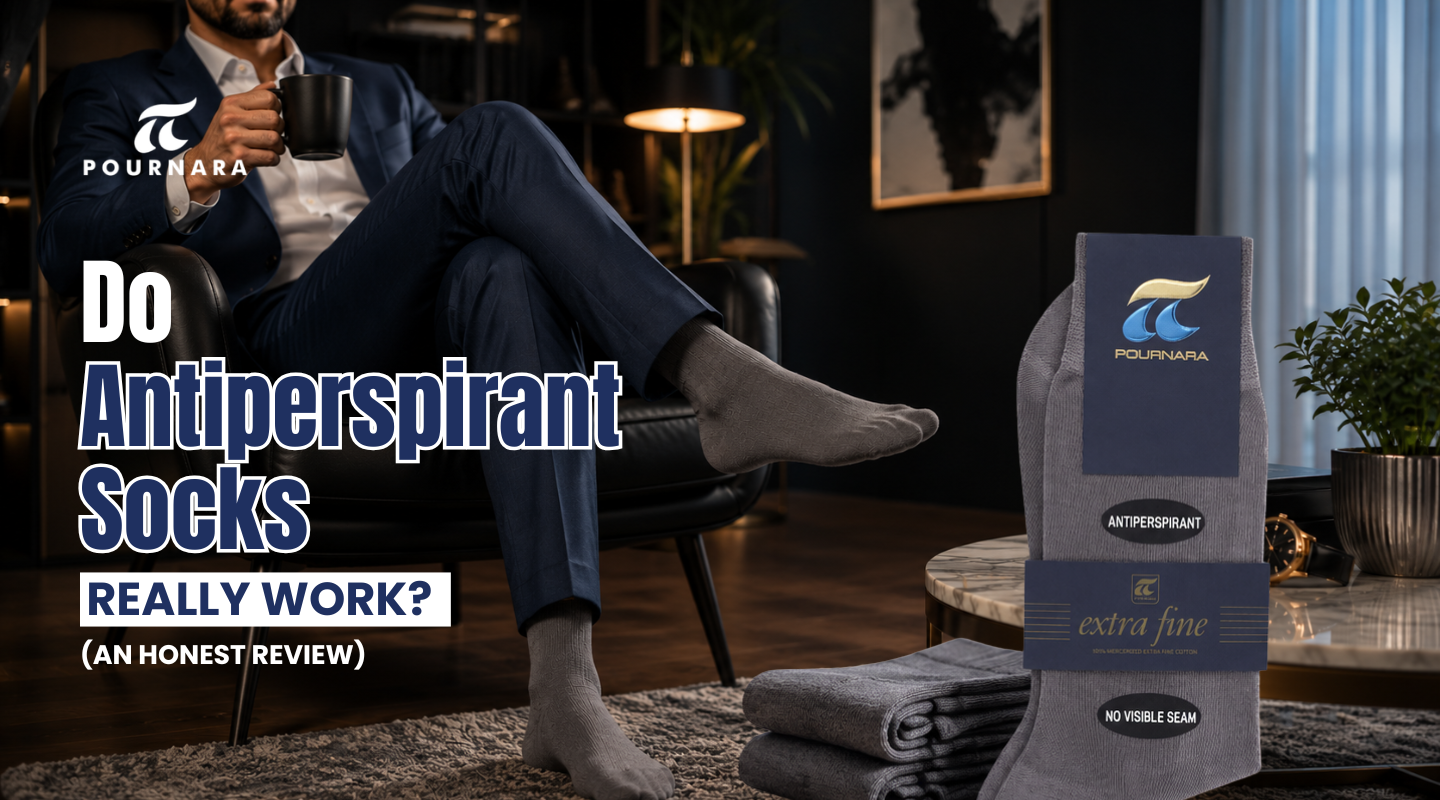
Yes, antiperspirant socks can work, but the honest answer depends on which type you buy. Socks treated with aluminum based compounds can reduce actual sweat output, while silver ion and antimicrobial socks only control odor causing bacteria without reducing how much you sweat. Knowing the difference matters more than any marketing claim on the packaging, and it is the focus of this review.
Antiperspirant socks are socks made with a fiber treatment or embedded compound designed to reduce moisture, odor, or both, directly at the source instead of relying on a separate spray, powder, or roll-on product. Unlike a topical antiperspirant you apply to your skin each morning, the treatment is knitted or bonded into the sock fabric itself, so it works passively every time you put the sock on. The term “antiperspirant socks” gets used loosely across the sock industry, and that looseness is where most of the confusion starts. Not every sock marketed this way actually reduces sweat production. Some only manage the smell that sweat produces once bacteria interact with it.
There are two distinct technologies behind most antiperspirant sock claims, and they do very different jobs.
Some performance socks use fibers treated with aluminum based compounds, similar in principle to the active ingredient in underarm antiperspirants. When these compounds contact the skin, they temporarily form a superficial plug within the sweat duct, which limits how much moisture reaches the surface of the foot. This is the mechanism that qualifies a product as a true antiperspirant rather than simply an odor control product. Clinical antiperspirant research on aluminum chloride and aluminum chlorohydrate compounds shows sweat reduction in the range of roughly 30 to 50 percent when used consistently, though results vary by concentration, skin contact time, and individual sweat gland activity.
Many socks marketed as antiperspirant are actually built around silver ions or other antimicrobial fibers. These work by disrupting the cell function of odor causing bacteria on contact, which is a genuinely useful feature, but it is a different job than reducing sweat. Sweat itself is essentially odorless. The smell develops when bacteria on the skin break down sweat and its proteins. Silver ion fabric interrupts that bacterial process, so feet smell better, but the sock is not actually lowering how much you sweat. If a product description only mentions “odor control,” “antimicrobial,” or “antibacterial” fibers without referencing an aluminum or astringent compound, it almost certainly falls into this second category, regardless of how the packaging brands it.
Before judging whether any product works, it helps to understand the scale of the problem it is solving. A pair of feet contains roughly 250,000 sweat glands, more per square inch than almost anywhere else on the body, and they can produce up to half a pint of sweat over the course of a day, according to health information reviewed by Patient.info. Those glands do not just activate from heat or exercise. They are also triggered by stress, hormonal changes, and simply spending long hours in closed shoes.
For a smaller group of people, this goes well beyond normal. Hyperhidrosis, a medical condition involving excessive sweating beyond what the body needs for temperature regulation, affects an estimated 4.8 percent of U.S. adults, or roughly 15.3 million people, according to a peer reviewed prevalence study published on PMC. Among people with hyperhidrosis, plantar or foot sweating is reported by approximately 64 percent of cases, according to survey data compiled by the International Hyperhidrosis Society, making feet one of the most commonly affected areas alongside the underarms and palms.
This is the core question of this review, and the honest answer is that it depends entirely on which category of sock you are holding. If the sock contains an aluminum based or similarly astringent compound applied to the fiber, there is a reasonable, chemistry backed case that it will reduce sweat output at the point of contact, in line with how topical antiperspirants function elsewhere on the body. If the sock relies on silver ion, copper, or general antimicrobial fiber technology, it is very likely doing an effective job at odor control and bacterial management, but it is not reducing the volume of sweat your feet produce.
Neither category is dishonest by definition, but plenty of product marketing blurs the line between the two, using the word “antiperspirant” as a general freshness term rather than a precise description of mechanism. A useful rule of thumb: if you cannot find any mention of an active astringent or aluminum compound in the materials or product description, assume the sock is managing odor, not sweat volume, and shop accordingly.
It is also worth noting what these socks are not. They are not a substitute for a medical diagnosis or treatment if you suspect true hyperhidrosis. For persistent, disruptive sweating, a physician can evaluate options such as prescription strength antiperspirants, iontophoresis, or other clinical treatments that a sock, however well engineered, cannot replicate.
Antiperspirant and odor control socks tend to deliver the most noticeable, real world benefit to a specific set of situations:
If you are dealing with diagnosed or severe hyperhidrosis, treat antiperspirant socks as a helpful daily layer rather than a primary treatment, and speak with a healthcare provider about medical grade options.
Here is how antiperspirant and odor control socks compare to the other common approaches to sweaty feet.
| Solution | How It Works | Reduces Sweat Volume | Controls Odor | Best For |
| Aluminum treated antiperspirant socks | Astringent compound temporarily constricts sweat ducts at the skin surface | Yes, moderately | Yes, indirectly | Daily wear, mild to moderate sweating |
| Silver ion or antimicrobial socks | Silver ions disrupt bacterial cell function on contact | No | Yes, directly | Odor prevention, everyday freshness |
| Foot antiperspirant spray or roll on | Same aluminum chemistry as underarm antiperspirants, applied topically | Yes, often more concentrated | Yes, indirectly | Moderate to significant sweating |
| Medicated or activated charcoal insoles | Absorbs moisture and traps odor within the insole material | No | Yes, partially | Shoe freshness between wears |
| Plain moisture wicking socks | Fiber structure pulls moisture away from skin without any active compound | No | No, indirectly only | General comfort, all day standing |
Once you know what to look for, the shopping decision gets much simpler. Pournara’s Antiperspirant Collection for men and Antiperspirant Collection for women are built with extra fine, moisture-managing construction designed for full workdays, the kind of daily, all day scenario where this technology tends to matter most. If sweat volume, not just odor, is your primary concern, it is worth confirming directly with the product listing which mechanism the treatment uses before you buy, the same way this review recommends checking any sock brand’s materials.
If foot odor and general moisture during long shifts are more your concern than heavy sweating, our guide on the best socks for sweaty feet and foot pain and our breakdown of whether wool socks are good for sweaty feet cover additional fiber options worth comparing. If compression is also a factor in your workday, our Compression Socks Guide explains how graduated compression and moisture management can work together.
No sock eliminates odor completely, but a well made antiperspirant or antimicrobial sock significantly reduces the bacterial activity that causes odor, especially when paired with daily rotation and proper washing.
This varies by brand and fiber technology, but most fiber treatments gradually lose effectiveness over repeated washing. Many manufacturers rate their treatment for a specific number of washes, so check the product details and avoid fabric softener, which can accelerate the breakdown of both antiperspirant and moisture wicking fibers.
Most people tolerate antiperspirant and antimicrobial sock fibers well, since the treatment does not penetrate the skin the way a topical antiperspirant can. However, anyone with diabetes, neuropathy, or a diagnosed circulatory condition should check with a physician before introducing any new sock technology, particularly if compression is also involved.
They can help manage day to day symptoms and odor, but they are not a medical treatment for diagnosed hyperhidrosis. If sweating is severe enough to interfere with daily life, a healthcare provider can evaluate options such as prescription strength antiperspirants, iontophoresis, or other clinical treatments.
Moisture wicking socks move sweat away from the skin using fiber structure alone, with no active compound involved. Antiperspirant socks add an aluminum based or antimicrobial treatment on top of that base function, targeting sweat reduction or odor causing bacteria directly.
Yes, this is one of the strongest use cases, since athletic shoes trap heat and moisture more than everyday footwear. Look for a sock that combines the antiperspirant or antimicrobial treatment with cushioning and a snug, non slip fit for the best results during activity.
Wash after every wear, in cold water, and avoid fabric softener. Rotating between several pairs allows each pair to fully dry and helps the fiber treatment last longer between washes.
Antiperspirant socks are a real, useful category, but only when you understand which mechanism you are actually buying. Aluminum based fiber treatments can meaningfully reduce sweat at the source, while silver ion and antimicrobial fabrics are excellent at odor control without changing how much you sweat. Neither is a replacement for medical care if you suspect true hyperhidrosis, but for the everyday reality of long shifts, closed shoes, and warm weather, the right pair can make a noticeable difference.
If you want to try a pair built specifically for full workdays, explore Pournara’s Antiperspirant sock collection for men or the women’s Antiperspirant collection.
Pournara
We firmly believe that the internet should be available and accessible to anyone, and are committed to providing a website that is accessible to the widest possible audience, regardless of circumstance and ability.
To fulfill this, we aim to adhere as strictly as possible to the World Wide Web Consortium’s (W3C) Web Content Accessibility Guidelines 2.1 (WCAG 2.1) at the AA level. These guidelines explain how to make web content accessible to people with a wide array of disabilities. Complying with those guidelines helps us ensure that the website is accessible to all people: blind people, people with motor impairments, visual impairment, cognitive disabilities, and more.
This website utilizes various technologies that are meant to make it as accessible as possible at all times. We utilize an accessibility interface that allows persons with specific disabilities to adjust the website’s UI (user interface) and design it to their personal needs.
Additionally, the website utilizes an AI-based application that runs in the background and optimizes its accessibility level constantly. This application remediates the website’s HTML, adapts Its functionality and behavior for screen-readers used by the blind users, and for keyboard functions used by individuals with motor impairments.
If you’ve found a malfunction or have ideas for improvement, we’ll be happy to hear from you. You can reach out to the website’s operators by using the following email
Our website implements the ARIA attributes (Accessible Rich Internet Applications) technique, alongside various different behavioral changes, to ensure blind users visiting with screen-readers are able to read, comprehend, and enjoy the website’s functions. As soon as a user with a screen-reader enters your site, they immediately receive a prompt to enter the Screen-Reader Profile so they can browse and operate your site effectively. Here’s how our website covers some of the most important screen-reader requirements, alongside console screenshots of code examples:
Screen-reader optimization: we run a background process that learns the website’s components from top to bottom, to ensure ongoing compliance even when updating the website. In this process, we provide screen-readers with meaningful data using the ARIA set of attributes. For example, we provide accurate form labels; descriptions for actionable icons (social media icons, search icons, cart icons, etc.); validation guidance for form inputs; element roles such as buttons, menus, modal dialogues (popups), and others. Additionally, the background process scans all the website’s images and provides an accurate and meaningful image-object-recognition-based description as an ALT (alternate text) tag for images that are not described. It will also extract texts that are embedded within the image, using an OCR (optical character recognition) technology. To turn on screen-reader adjustments at any time, users need only to press the Alt+1 keyboard combination. Screen-reader users also get automatic announcements to turn the Screen-reader mode on as soon as they enter the website.
These adjustments are compatible with all popular screen readers, including JAWS and NVDA.
Keyboard navigation optimization: The background process also adjusts the website’s HTML, and adds various behaviors using JavaScript code to make the website operable by the keyboard. This includes the ability to navigate the website using the Tab and Shift+Tab keys, operate dropdowns with the arrow keys, close them with Esc, trigger buttons and links using the Enter key, navigate between radio and checkbox elements using the arrow keys, and fill them in with the Spacebar or Enter key.Additionally, keyboard users will find quick-navigation and content-skip menus, available at any time by clicking Alt+1, or as the first elements of the site while navigating with the keyboard. The background process also handles triggered popups by moving the keyboard focus towards them as soon as they appear, and not allow the focus drift outside it.
Users can also use shortcuts such as “M” (menus), “H” (headings), “F” (forms), “B” (buttons), and “G” (graphics) to jump to specific elements.
We aim to support the widest array of browsers and assistive technologies as possible, so our users can choose the best fitting tools for them, with as few limitations as possible. Therefore, we have worked very hard to be able to support all major systems that comprise over 95% of the user market share including Google Chrome, Mozilla Firefox, Apple Safari, Opera and Microsoft Edge, JAWS and NVDA (screen readers).
Despite our very best efforts to allow anybody to adjust the website to their needs. There may still be pages or sections that are not fully accessible, are in the process of becoming accessible, or are lacking an adequate technological solution to make them accessible. Still, we are continually improving our accessibility, adding, updating and improving its options and features, and developing and adopting new technologies. All this is meant to reach the optimal level of accessibility, following technological advancements. For any assistance, please reach out to