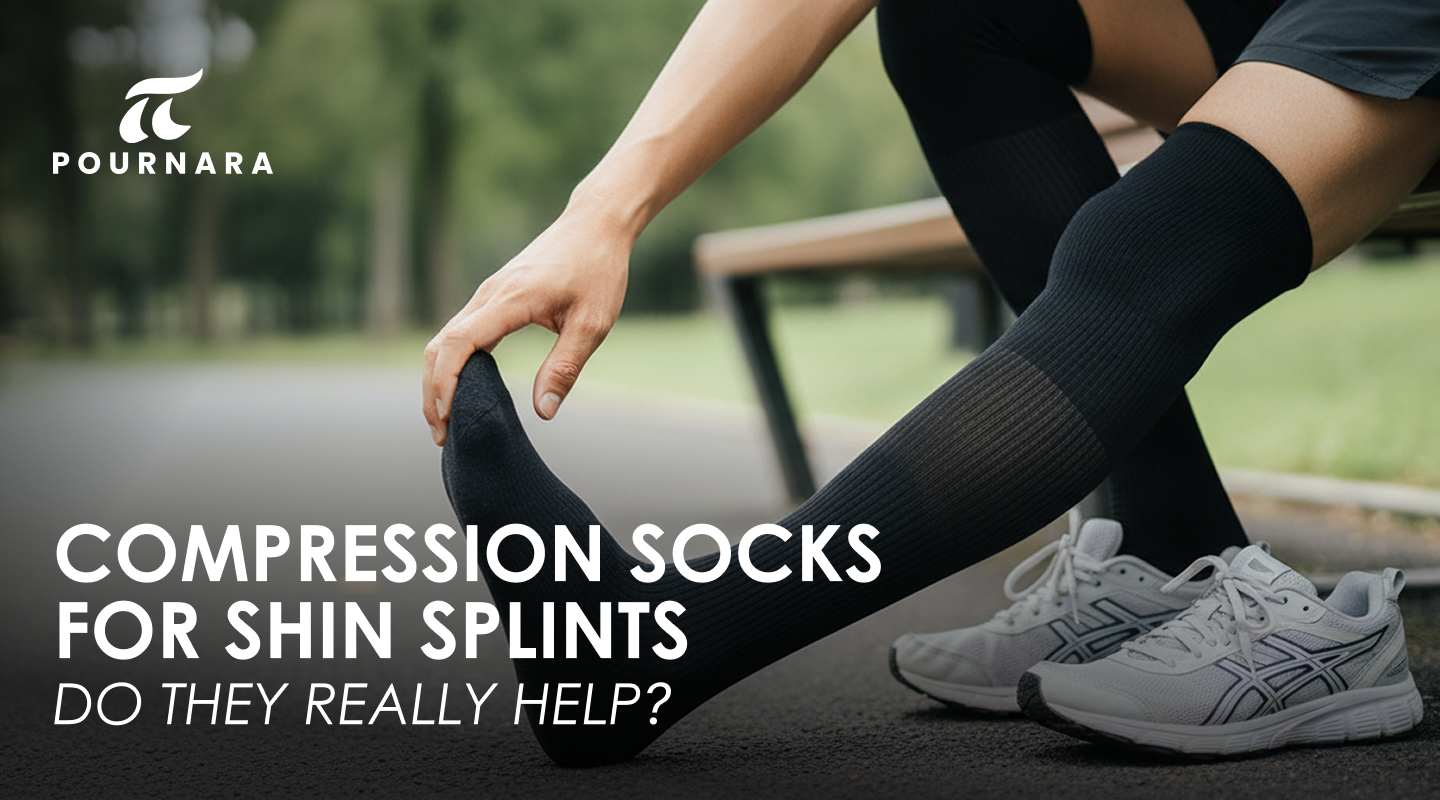
If you’ve experienced the sharp pain along your shinbone after a run or intense workout, you’re familiar with shin splints. This common condition affects runners, athletes, and anyone engaged in high-impact activities. The question many ask is: can compression socks for shin splints actually provide relief? Let’s explore what research reveals.
Shin splints, medically known as medial tibial stress syndrome (MTSS), occur when repetitive stress causes inflammation in the muscles, tendons, and bone tissue around your tibia. This creates sustained internal pressure and swelling, leading to pain along the inner edge of your shin. According to research from the University of Calgary, MTSS accounts for approximately 13-17% of all running-related injuries.
Shin splints support socks: utilizing graduated compression technology pressure is highest at the ankle and gradually decreases upward. This design offers several therapeutic benefits supported by scientific research:
Enhanced Blood Circulation: A 2017 study published in the Journal of Strength and Conditioning Research found that graduated compression garments increased arterial blood flow by up to 40% during activity and 30% during recovery. This improved circulation delivers oxygen and nutrients to affected areas while removing metabolic waste products more efficiently.
Reduced Muscle Vibration: Research from the Australian Institute of Sport demonstrated that compression garments significantly reduce muscle oscillation during high-impact activities. Every foot strike causes muscle vibration that creates microtears leading to inflammation. Compression socks and shin splints management work together because compression stabilizes muscles, minimizing excessive movement.
Inflammation Control: According to sports medicine research from Loughborough University, targeted compression prevents fluid buildup and reduces swelling by improving lymphatic flow, which accelerates the removal of inflammation-related substances.
Structural Support: Biomechanical studies show that compression provides counter-pressure against impact, reducing stress on the tibia and surrounding tissues.
The table below outlines recommended compression levels for shin splints based on clinical guidelines from the American College of Sports Medicine (ACSM):
| Compression Level | Use Case | Effectiveness |
| 15-20 mmHg | Prevention and mild cases | Reduces muscle fatigue during activity |
| 20-30 mmHg | Active treatment and severe symptoms | Manages inflammation and supports recovery |
| 30-40 mmHg | Medical-grade (requires prescription) | Used for severe circulation issues |
Table Context: This comparison shows the appropriate compression levels for different shin splint scenarios. For most athletes and active individuals, 15-20 mmHg is sufficient for prevention, while 20-30 mmHg is recommended during active recovery from shin splints.
Yes, footless compression sleeves are highly effective for shin splints. A 2019 study in the Sports Medicine journal found that calf compression sleeves provided similar benefits to full socks for reducing exercise-induced muscle damage. They target the calf and shin area where support is needed most while allowing feet to breathe. They’re ideal for athletes needing specific footwear and provide better temperature regulation. However, they don’t compress the foot itself, so if you experience foot swelling, full-coverage socks may be better.
Open-toe compression socks offer several advantages: improved comfort and breathability in warm weather, accommodation for longer feet or toe issues like bunions, easier application for those with limited mobility, and flexibility to wear with sandals. Research from the International Journal of Sports Medicine notes that open-toe designs maintain therapeutic compression levels on the leg while preventing discomfort in the forefoot area. They also allow healthcare providers to monitor circulation through toe coloration.
Best Time of Day: Put compression socks on in the morning before getting out of bed, when your legs have the least fluid buildup. A study from the Journal of Vascular Surgery confirmed that early morning application, before gravitational pooling occurs, maximizes compression effectiveness throughout the day.
During Activity: Wear them during exercise to provide real-time support and reduce muscle vibration.
After Exercise: Continue wearing for 2-3 hours post-workout to aid recovery. Research from the British Journal of Sports Medicine found that post-exercise compression significantly reduced delayed onset muscle soreness (DOMS).
Daily Wear: If experiencing active shin splints, wear throughout the day but remove before bed unless prescribed by your doctor.
Avoid compression socks if you have:
According to vascular medicine guidelines from Johns Hopkins University, incorrectly sized compression garments can act as a tourniquet and restrict blood flow rather than improve it. Always consult a healthcare provider before using compression therapy if you have circulation issues, diabetes, or chronic medical conditions.
Pregnancy brings unique challenges with shin splints due to additional weight and posture changes. Research from the American College of Obstetricians and Gynecologists (ACOG) emphasizes modified treatment approaches:
RICE Method Modified: Rest, ice (15-20 minutes wrapped in a towel), compression, and elevation. Ensure proper sock fit as leg size may fluctuate during pregnancy.
Low-Impact Exercise: Switch to swimming, cycling, or walking on softer surfaces. A 2020 study from the University of North Carolina found that aquatic exercise during pregnancy reduces lower limb stress by up to 85%.
Supportive Footwear: Wear shoes with proper arch support and cushioning at all times.
Gentle Stretching: Perform calf stretches without overextending.
Elevation: Regularly elevate legs throughout the day to reduce swelling.
Pain Management: Consult your healthcare provider about safe options. The Mayo Clinic recommends acetaminophen as the preferred pain reliever during pregnancy, as nonsteroidal anti-inflammatory drugs (NSAIDs) are generally avoided, especially in the third trimester.
If pain is severe or accompanied by unusual swelling or redness, contact your healthcare provider immediately.
According to sports medicine research from Stanford University, shin splints respond best to multimodal treatment. While compression socks for shin splints help alleviate symptoms, they work best combined with:
A 2018 meta-analysis in the Clinical Journal of Sport Medicine found that comprehensive treatment reduces shin splint recovery time by an average of 40% compared to rest alone. Recovery typically takes 3-6 months with proper treatment, though some cases may require up to a year.
Scientific evidence supports that compression socks help with shin splints by improving circulation, reducing muscle vibration, controlling inflammation, and providing structural support. However, research consistently shows they’re most effective as part of a comprehensive treatment approach rather than a standalone solution.
For best results, combine graduated compression garments with adequate rest, proper footwear, progressive training methods, and targeted exercises. If symptoms persist beyond 2-3 weeks or worsen despite conservative treatment, consult a sports medicine physician or physical therapist for evaluation.
Pournara
We firmly believe that the internet should be available and accessible to anyone, and are committed to providing a website that is accessible to the widest possible audience, regardless of circumstance and ability.
To fulfill this, we aim to adhere as strictly as possible to the World Wide Web Consortium’s (W3C) Web Content Accessibility Guidelines 2.1 (WCAG 2.1) at the AA level. These guidelines explain how to make web content accessible to people with a wide array of disabilities. Complying with those guidelines helps us ensure that the website is accessible to all people: blind people, people with motor impairments, visual impairment, cognitive disabilities, and more.
This website utilizes various technologies that are meant to make it as accessible as possible at all times. We utilize an accessibility interface that allows persons with specific disabilities to adjust the website’s UI (user interface) and design it to their personal needs.
Additionally, the website utilizes an AI-based application that runs in the background and optimizes its accessibility level constantly. This application remediates the website’s HTML, adapts Its functionality and behavior for screen-readers used by the blind users, and for keyboard functions used by individuals with motor impairments.
If you’ve found a malfunction or have ideas for improvement, we’ll be happy to hear from you. You can reach out to the website’s operators by using the following email
Our website implements the ARIA attributes (Accessible Rich Internet Applications) technique, alongside various different behavioral changes, to ensure blind users visiting with screen-readers are able to read, comprehend, and enjoy the website’s functions. As soon as a user with a screen-reader enters your site, they immediately receive a prompt to enter the Screen-Reader Profile so they can browse and operate your site effectively. Here’s how our website covers some of the most important screen-reader requirements, alongside console screenshots of code examples:
Screen-reader optimization: we run a background process that learns the website’s components from top to bottom, to ensure ongoing compliance even when updating the website. In this process, we provide screen-readers with meaningful data using the ARIA set of attributes. For example, we provide accurate form labels; descriptions for actionable icons (social media icons, search icons, cart icons, etc.); validation guidance for form inputs; element roles such as buttons, menus, modal dialogues (popups), and others. Additionally, the background process scans all the website’s images and provides an accurate and meaningful image-object-recognition-based description as an ALT (alternate text) tag for images that are not described. It will also extract texts that are embedded within the image, using an OCR (optical character recognition) technology. To turn on screen-reader adjustments at any time, users need only to press the Alt+1 keyboard combination. Screen-reader users also get automatic announcements to turn the Screen-reader mode on as soon as they enter the website.
These adjustments are compatible with all popular screen readers, including JAWS and NVDA.
Keyboard navigation optimization: The background process also adjusts the website’s HTML, and adds various behaviors using JavaScript code to make the website operable by the keyboard. This includes the ability to navigate the website using the Tab and Shift+Tab keys, operate dropdowns with the arrow keys, close them with Esc, trigger buttons and links using the Enter key, navigate between radio and checkbox elements using the arrow keys, and fill them in with the Spacebar or Enter key.Additionally, keyboard users will find quick-navigation and content-skip menus, available at any time by clicking Alt+1, or as the first elements of the site while navigating with the keyboard. The background process also handles triggered popups by moving the keyboard focus towards them as soon as they appear, and not allow the focus drift outside it.
Users can also use shortcuts such as “M” (menus), “H” (headings), “F” (forms), “B” (buttons), and “G” (graphics) to jump to specific elements.
We aim to support the widest array of browsers and assistive technologies as possible, so our users can choose the best fitting tools for them, with as few limitations as possible. Therefore, we have worked very hard to be able to support all major systems that comprise over 95% of the user market share including Google Chrome, Mozilla Firefox, Apple Safari, Opera and Microsoft Edge, JAWS and NVDA (screen readers).
Despite our very best efforts to allow anybody to adjust the website to their needs. There may still be pages or sections that are not fully accessible, are in the process of becoming accessible, or are lacking an adequate technological solution to make them accessible. Still, we are continually improving our accessibility, adding, updating and improving its options and features, and developing and adopting new technologies. All this is meant to reach the optimal level of accessibility, following technological advancements. For any assistance, please reach out to