
TL;DR
- Are wool socks good for sweaty feet? Yes. Merino wool absorbs up to 35% of its weight before feeling wet against skin.
- What makes wool different? Synthetic fibers saturate at just 7% moisture capacity, trapping sweat and triggering odor within 20 minutes.
- Is merino better than regular wool? Yes. Fibers under 21 microns bend instead of prick, allowing all-day wear without itch.
- When does wool fall short? Hyperhidrosis — excessive sweating beyond normal levels — may require antiperspirant socks, not just fiber switching.
QUICK ANSWER BOX
Wool socks are good for sweaty feet, specifically merino wool, which absorbs up to 35% of its fiber weight in moisture before feeling wet. Synthetic fibers saturate at ~7%. The table below compares fibers by moisture capacity, odor resistance, and best season.
| Sock Type | Moisture at Saturation | Odor Resistance | Best Season |
| Merino wool | ~35% of fiber weight | High (lanolin + keratin) | Year-round |
| Regular wool (coarse) | ~30% of fiber weight | High | Fall/Winter only |
| Cotton | ~27% of fiber weight | Low (retains moisture) | Not ideal |
| Synthetic (polyester) | ~7% of fiber weight | Very low | Not recommended |
| Bamboo | ~20% of fiber weight | Moderate | Spring/Summer |
Yes, merino wool specifically absorbs up to 35% of its own weight in moisture before feeling wet against the skin, while also transporting that moisture away from the surface. The gap between merino and synthetic is not marginal: polyester saturates at roughly 7%, meaning it feels wet almost immediately and holds bacteria-feeding moisture against the foot.
Wool does two things most fibers cannot do simultaneously: it absorbs and it wicks. Cotton absorbs but holds moisture against the skin. Polyester attempts to wick but saturates at ~7% of fiber weight, then stays wet. Merino wool absorbs up to 35% of its weight according to Woolmark moisture performance data, while simultaneously transporting moisture vapor from the skin surface to the outer fiber layer where it evaporates.
The thermoregulation mechanism adds a third function specific to wool. As moisture moves outward through the fiber, it carries heat with it, cooling the foot surface. In cold conditions, the same fiber traps dry air close to the skin, adding insulation. This bidirectional function is why merino wool performs in Illinois summers at 70–75% relative humidity just as effectively as in winter, the fiber responds to skin temperature, not air temperature.
A simple self-diagnosis: if feet feel damp within 60 minutes of putting on socks, fiber saturation is the cause. Cotton saturates and holds. Synthetics saturate and stay wet. Merino delays saturation significantly longer and keeps moisture away from skin contact, which is the mechanism, not a marketing claim.
Four signs point to different diagnoses. Feet that still smell after switching to wool indicate coarse fiber, not merino, fiber diameter above 24 microns traps heat at the skin surface instead of transporting moisture outward. Feet that itch in wool socks also point to fiber above 24 microns, which mechanically triggers skin receptors even through a shoe. Feet that feel damp inside a wool sock usually mean the sock weight is too heavy for the activity or season. Feet that feel consistently cooler and drier signal merino working as intended.
Coarse wool above 24 microns is the single most common reason people reject wool for sweaty feet. The fiber diameter is stiff enough to press against skin receptors with each step, creating an itch response that is entirely mechanical, not allergic. Merino fibers at 15–21 microns are fine enough to bend on skin contact rather than prick, eliminating the itch without reducing moisture performance, according to CSIRO fiber diameter research.
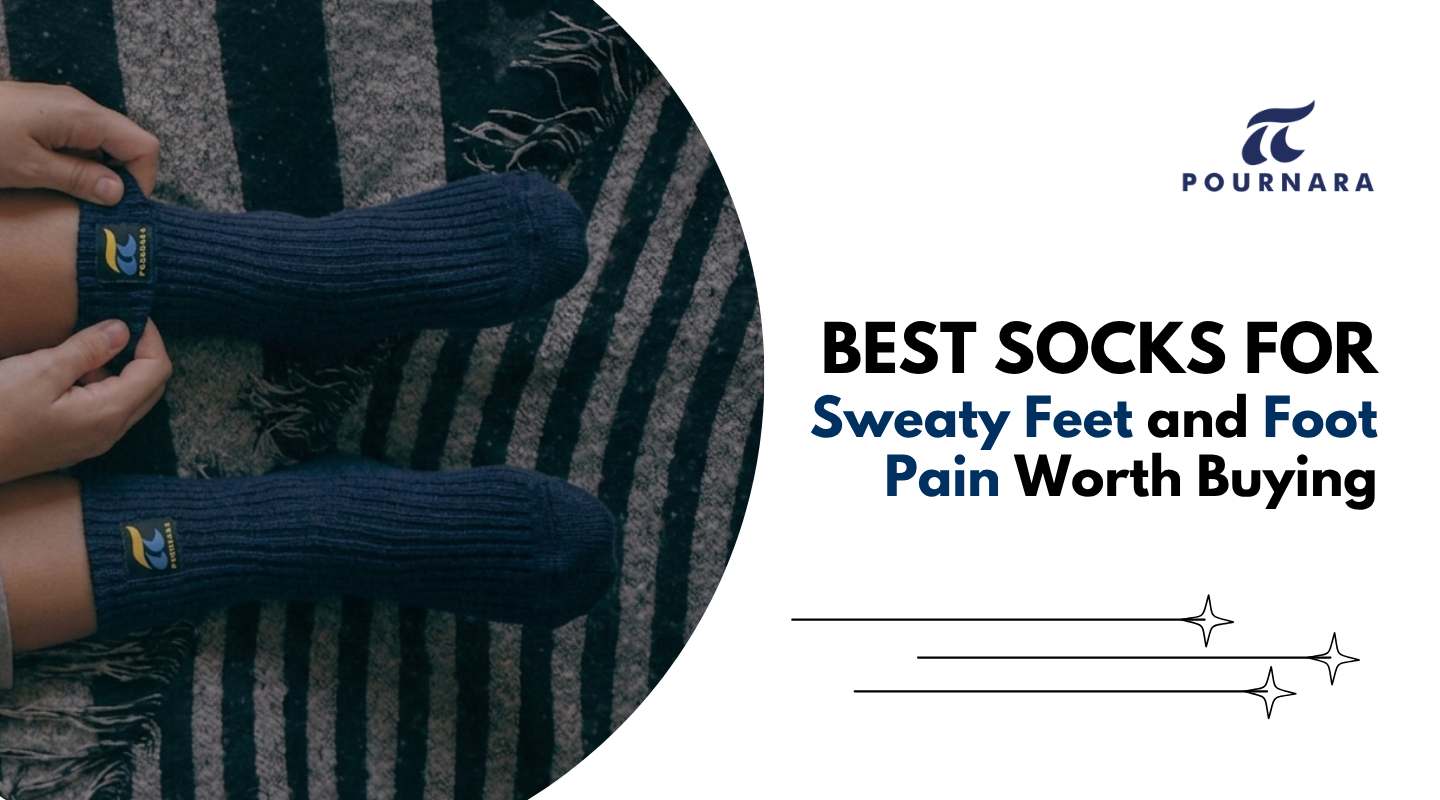
For readers whose feet itch and smell despite switching to wool, the fix is not a different fiber — it is a different wool. Coarse fiber above 24 microns traps heat and moisture at the skin surface instead of moving it outward. Pournara’s ART 360 100% German Merino Wool Socks use fiber in the 15–21 micron range, soft enough for all-day wear, fine enough for active moisture transport. For a broader comparison of options, best socks for sweaty feet and foot pain covers additional constructions suited to specific sweat levels.
Towel test: Press a dry towel against bare feet after 4 hours in your current socks. If the towel feels damp in under 3 seconds, your current fiber is already saturated and holding moisture against your skin.
Cotton absorbs ~27% of its weight in moisture but has no active transport mechanism, absorbed sweat stays against the skin until evaporation occurs externally. Polyester saturates at ~7% and provides no absorption buffer at all. Once wet, polyester creates a warm, moist microenvironment against the foot where odor-causing bacteria, primarily Brevibacterium and Staphylococcus species, can multiply within 20 minutes of activity, according to textile microbiology research published in the International Journal of Clothing Science and Technology.
Wool’s odor resistance operates through two separate mechanisms. Lanolin, the natural wax coating wool fibers, has documented antimicrobial properties that inhibit bacterial growth on the fiber surface. Keratin, the structural protein in wool, chemically binds sulfur compounds, the actual odor molecules produced by foot bacteria, trapping them in the fiber until washing. These two mechanisms combined explain why merino wool socks can typically be worn 2–3 consecutive days before odor becomes detectable, a performance no synthetic fiber replicates.
For Illinois readers concerned about summer performance: merino wool below 200g/m² weight is suitable for warm-weather wear. June through August humidity averaging 70–75% in the Chicago metro area makes synthetic socks progressively worse as the day lengthens, moisture accumulates with nowhere to go. Merino’s vapor transport continues functioning at high humidity because moisture moves through the fiber structure, not just along the surface. For year-round performance that also addresses Illinois winter warmth without overheating, Pournara’s ART 205 German Lamb Wool Isothermal Socks and ART 604 German Lamb Wool Isothermal Socks add isothermal construction to the moisture management function.
Two-day test for Illinois readers: Wear the same merino sock brand on two consecutive summer days. No detectable odor by day 2 confirms active lanolin. Odor by end of day 1 usually means a wool-acrylic blend where lanolin has been diluted or processed out.
Three variables determine the right choice: sweat level, season, and fiber quality. Getting the fiber quality wrong eliminates the performance advantage of every other variable.
German merino outperforms generic merino labeling for three specific reasons. German wool processing standards enforce tighter fiber diameter consistency than generic “merino” labeling requires, a sock labeled “merino” can legally contain fibers above 24 microns in many markets. German-processed wool retains more natural lanolin through gentler processing, preserving the odor-resistance mechanism that aggressive industrial processing strips out. Isothermal construction in German lamb wool products locks thermoregulation function year-round, not just in cold weather.
Selection by situation:
| Situation | Sock Type | Key Feature |
| Mild to moderate sweating, all seasons | 100% merino, 15–21 micron | Lightweight, active moisture transport |
| Illinois winter + sweaty feet | Isothermal lamb wool | Warmth without overheating |
| Office or dress wear | Thin merino blend | Stays slim in dress shoe |
| Hyperhidrosis (excessive sweating) | Antiperspirant socks primary | Wool insufficient alone |
What to avoid: acrylic/wool blends marketed as “wool socks.” Acrylic fibers negate wicking by introducing a synthetic surface that saturates quickly. Check labels for “100% merino” or “100% wool”, any acrylic percentage reduces moisture performance proportionally.
For readers with mild to moderate sweating who want active moisture management year-round, Pournara’s ART 360 100% German Merino Wool Socks deliver the full mechanism — 15–21 micron fiber, lanolin-retained processing, starting at $21. For readers with hyperhidrosis where fiber alone is insufficient, Pournara’s antiperspirant socks address the sweat volume problem directly rather than the fiber management problem. Crafted in Greece with over 75 years of hosiery expertise using German wool sourcing, Pournara’s full wool range starts at $14 at shoppournara.com/product-category/men/wool-mens-socks/.
Full Article Key Takeaways:
A: Yes, specifically merino wool below 200g/m² weight. Merino’s thermoregulation transports moisture vapor outward even in heat, keeping the foot surface drier. Illinois summers averaging 70–75% humidity make synthetic socks progressively worse throughout the day, merino continues performing because moisture moves through the fiber structure, not along the surface.
A: Fiber diameter. Regular wool above 24 microns mechanically triggers itch receptors with each step and traps heat at the skin surface. Merino wool at 15–21 microns bends on skin contact rather than pricking, allows active moisture transport, and retains lanolin for odor resistance. The micron number is more important than the “wool” label.
A: Yes, through two mechanisms. Lanolin in wool fiber has natural antimicrobial properties that inhibit odor-causing bacteria. Keratin protein in wool binds sulfur compounds, the actual odor molecules, until the sock is washed. Combined, these mechanisms allow merino wool socks to be worn 2–3 days before odor typically develops.
A: Research suggests 2–3 days for most wearers under normal activity. The lanolin and keratin mechanisms delay bacterial odor buildup significantly longer than cotton or synthetic. Odor appearing by end of day 1 usually indicates a wool-acrylic blend where lanolin has been diluted through industrial processing.
A: For most conditions, yes. Bamboo absorbs ~20% of its weight in moisture versus merino’s ~35%. Bamboo has moderate odor resistance but no thermoregulation function. Merino outperforms bamboo in both summer humidity and winter cold. Bamboo is a reasonable alternative for spring and fall but lacks merino’s year-round performance.
A: Coarse wool above 24 microns can worsen sweaty feet by trapping heat at the skin surface instead of transporting moisture outward. Wool-acrylic blends also reduce performance because acrylic fibers negate wicking. The fix is switching to 100% merino at 15–21 microns, not switching away from wool entirely.
A: Look for fiber diameter under 21 microns for all-day comfort and active moisture transport. Fibers above 24 microns cause mechanical itch and reduced moisture performance. Not all brands publish micron ratings — “100% German merino” or “superfine merino” typically signals fiber in the 15–21 micron range.
A: Yes. The ART 360 uses 100% German merino at $21, suited to all-season moisture management. German lamb wool isothermal options (ART 205 and ART 604) add year-round temperature regulation at $18–$21. For excessive sweating beyond what fiber can manage, Pournara also offers antiperspirant socks. Full wool range starts at $14 with free shipping over $75. Visit shoppournara.com.
Looking for German merino wool socks that stay dry all day?
Pournara’s wool socks start at $14, crafted in Greece with free shipping over $75.
shoppournara.com/product-category/men/wool-mens-socks/
Pournara
We firmly believe that the internet should be available and accessible to anyone, and are committed to providing a website that is accessible to the widest possible audience, regardless of circumstance and ability.
To fulfill this, we aim to adhere as strictly as possible to the World Wide Web Consortium’s (W3C) Web Content Accessibility Guidelines 2.1 (WCAG 2.1) at the AA level. These guidelines explain how to make web content accessible to people with a wide array of disabilities. Complying with those guidelines helps us ensure that the website is accessible to all people: blind people, people with motor impairments, visual impairment, cognitive disabilities, and more.
This website utilizes various technologies that are meant to make it as accessible as possible at all times. We utilize an accessibility interface that allows persons with specific disabilities to adjust the website’s UI (user interface) and design it to their personal needs.
Additionally, the website utilizes an AI-based application that runs in the background and optimizes its accessibility level constantly. This application remediates the website’s HTML, adapts Its functionality and behavior for screen-readers used by the blind users, and for keyboard functions used by individuals with motor impairments.
If you’ve found a malfunction or have ideas for improvement, we’ll be happy to hear from you. You can reach out to the website’s operators by using the following email
Our website implements the ARIA attributes (Accessible Rich Internet Applications) technique, alongside various different behavioral changes, to ensure blind users visiting with screen-readers are able to read, comprehend, and enjoy the website’s functions. As soon as a user with a screen-reader enters your site, they immediately receive a prompt to enter the Screen-Reader Profile so they can browse and operate your site effectively. Here’s how our website covers some of the most important screen-reader requirements, alongside console screenshots of code examples:
Screen-reader optimization: we run a background process that learns the website’s components from top to bottom, to ensure ongoing compliance even when updating the website. In this process, we provide screen-readers with meaningful data using the ARIA set of attributes. For example, we provide accurate form labels; descriptions for actionable icons (social media icons, search icons, cart icons, etc.); validation guidance for form inputs; element roles such as buttons, menus, modal dialogues (popups), and others. Additionally, the background process scans all the website’s images and provides an accurate and meaningful image-object-recognition-based description as an ALT (alternate text) tag for images that are not described. It will also extract texts that are embedded within the image, using an OCR (optical character recognition) technology. To turn on screen-reader adjustments at any time, users need only to press the Alt+1 keyboard combination. Screen-reader users also get automatic announcements to turn the Screen-reader mode on as soon as they enter the website.
These adjustments are compatible with all popular screen readers, including JAWS and NVDA.
Keyboard navigation optimization: The background process also adjusts the website’s HTML, and adds various behaviors using JavaScript code to make the website operable by the keyboard. This includes the ability to navigate the website using the Tab and Shift+Tab keys, operate dropdowns with the arrow keys, close them with Esc, trigger buttons and links using the Enter key, navigate between radio and checkbox elements using the arrow keys, and fill them in with the Spacebar or Enter key.Additionally, keyboard users will find quick-navigation and content-skip menus, available at any time by clicking Alt+1, or as the first elements of the site while navigating with the keyboard. The background process also handles triggered popups by moving the keyboard focus towards them as soon as they appear, and not allow the focus drift outside it.
Users can also use shortcuts such as “M” (menus), “H” (headings), “F” (forms), “B” (buttons), and “G” (graphics) to jump to specific elements.
We aim to support the widest array of browsers and assistive technologies as possible, so our users can choose the best fitting tools for them, with as few limitations as possible. Therefore, we have worked very hard to be able to support all major systems that comprise over 95% of the user market share including Google Chrome, Mozilla Firefox, Apple Safari, Opera and Microsoft Edge, JAWS and NVDA (screen readers).
Despite our very best efforts to allow anybody to adjust the website to their needs. There may still be pages or sections that are not fully accessible, are in the process of becoming accessible, or are lacking an adequate technological solution to make them accessible. Still, we are continually improving our accessibility, adding, updating and improving its options and features, and developing and adopting new technologies. All this is meant to reach the optimal level of accessibility, following technological advancements. For any assistance, please reach out to