DIRECT ANSWER
You can wear compression socks in summer by choosing lightweight, breathable materials such as cotton or bamboo blends, putting them on first thing in the morning before swelling begins, and pairing them with moisture-wicking footwear. In Illinois summers, where humidity regularly exceeds 65 percent, the key is material selection and timing. Compression socks do not have to feel hot or uncomfortable in warm weather when chosen and worn correctly.
If you rely on compression socks for circulation support, leg fatigue, or medical reasons, summer in Illinois presents a genuine challenge. Temperatures in Chicago and across the state routinely reach the upper 80s and low 90s Fahrenheit from June through August, and humidity levels make heat feel more intense than the thermometer suggests.
The good news is that wearing compression socks in summer is not only possible but genuinely beneficial when done correctly. This guide covers who needs compression socks in summer, how to put them on and wear them comfortably in heat, what materials to choose, and practical tips for the specific audience groups who depend on them most: nurses and healthcare workers, travelers, pregnant women, and health-conscious active adults.
Compression socks are not exclusively a medical product. While they were historically recommended for specific clinical conditions, research and shifting consumer behavior have expanded their everyday use considerably. According to Ochsner Health, almost everyone can benefit from wearing compression socks, even with light or mild compression, to help manage swelling or soothe tired legs.
That said, certain groups have the most pressing need to continue wearing compression socks through Illinois summers regardless of the heat.
| Who | Why Summer Makes It Harder | Why They Still Need Compression |
| Nurses and Healthcare Workers | Long shifts on hard floors in warm facilities | Standing for 8-12 hours causes blood to pool in lower legs |
| Pregnant Women | Summer heat worsens pregnancy-related leg swelling | Compression reduces edema and lowers DVT risk |
| Frequent Travelers | Summer flight season, long drives, heat in terminals | Prolonged sitting raises blood clot risk significantly |
| Varicose Vein Sufferers | Heat dilates veins, increasing discomfort | Compression counteracts vein dilation and pain |
| Active Adults and Athletes | Summer training in humidity increases swelling | Supports muscle recovery and reduces fatigue |
| Older Adults (55+) | Circulation naturally slows with age and heat | Compression maintains blood flow and reduces edema |
Understanding the problem makes solving it easier. Heat causes blood vessels to dilate, which is the body’s natural cooling mechanism. When vessels dilate in the legs, more blood flows to the area, which can increase the sensation of pressure from compression socks, particularly in heavier materials that do not breathe well.
High humidity compounds this by reducing the evaporation of sweat, which is the primary way the body regulates surface temperature. A poorly constructed compression sock made from thick synthetic materials essentially creates a sealed, warm environment around the lower leg, which is why many people associate compression socks with summer discomfort.
The solution is not to stop wearing compression socks. The solution is to choose the right construction for summer conditions, which changes the experience significantly.
The fiber composition of a compression sock determines how it performs in summer heat more than any other variable. Here is how common materials compare for warm-weather wear.
| Material | Breathability | Moisture Management | Summer Suitability |
| Egyptian Cotton | High | Absorbs and releases moisture well | Excellent |
| Mercerized Cotton | High | Smooth, moisture-regulating | Excellent |
| Bamboo | Very High | Wicks moisture, naturally cooling | Excellent |
| Standard Synthetic (Nylon/Polyester) | Low to Moderate | Wicks fast but traps heat | Poor to Moderate |
| Heavy Wool Blend | Low | Absorbs moisture but retains heat | Not recommended for summer |
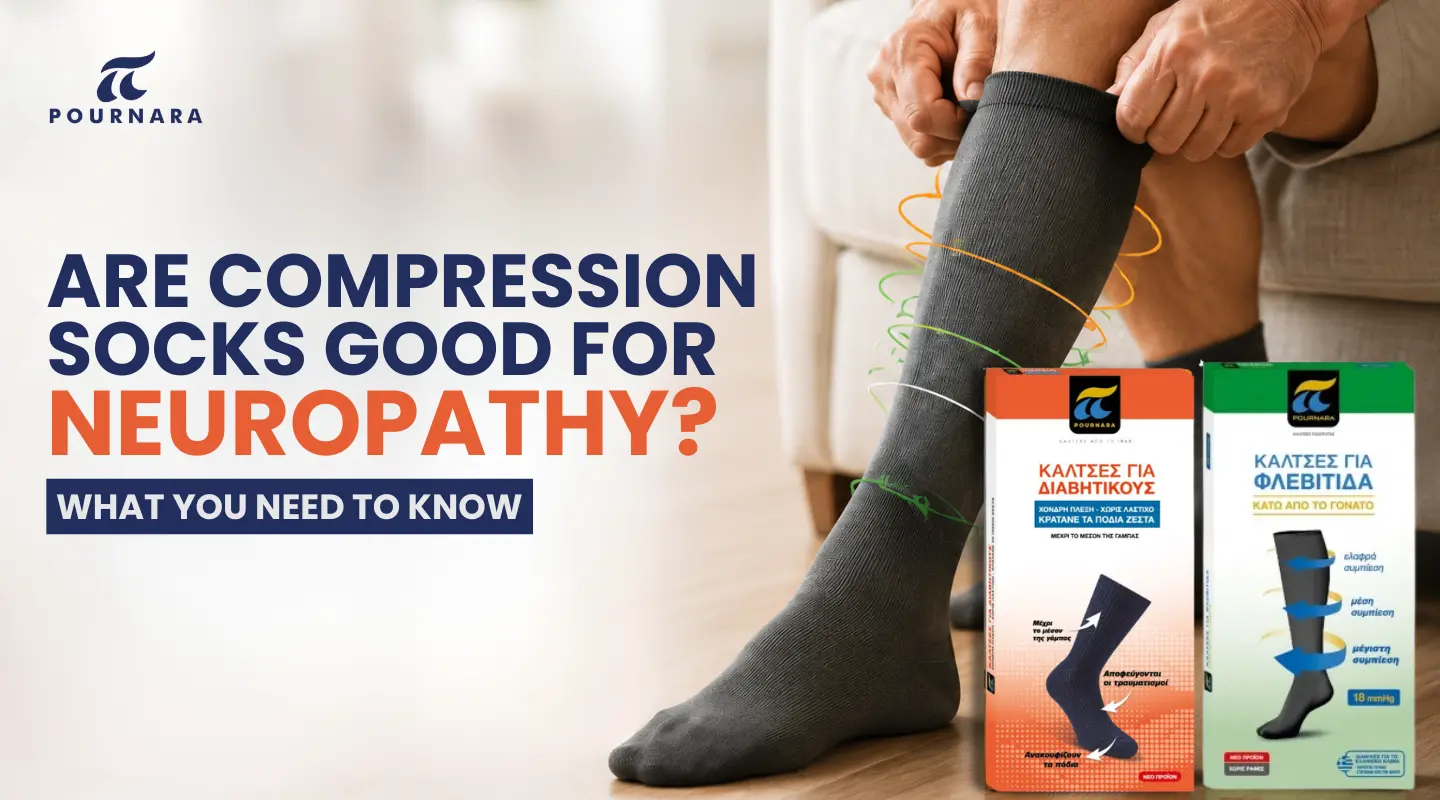
For Illinois summers, Egyptian cotton and bamboo-based compression socks offer the strongest combination of breathability, moisture management, and structural support. Pournara’s medical collection includes both Egyptian cotton and mercerized cotton compression options specifically engineered for people who need support without sacrificing comfort in warm conditions.
Compression is measured in millimeters of mercury (mmHg). For summer wear, starting at a lower compression level reduces discomfort while still providing meaningful circulatory benefit.
| Compression Level | mmHg Range | Best For in Summer |
| Mild / Everyday | 8-15 mmHg | Preventive use, travel, standing jobs, light swelling |
| Moderate | 15-20 mmHg | Varicose veins, pregnancy, nurses on long shifts |
| Firm / Medical Grade | 20-30 mmHg | Prescribed conditions, post-surgical, chronic venous insufficiency |
| Extra Firm | 30-40 mmHg | Prescribed only, consult a physician before summer use |
If you currently wear 20-30 mmHg socks year-round and find summer wear difficult, speak with your physician about whether a lower compression level is appropriate for the warmer months. Many people step down to 15-20 mmHg in summer without losing meaningful clinical benefit.
Knee-high compression socks provide the most complete circulatory benefit for most conditions but cover more skin. In summer, ankle-height or crew-cut compression socks can reduce the area of coverage, which some people find more comfortable. However, if your condition requires calf compression specifically, such as for varicose veins or DVT prevention, knee-high remains the clinically appropriate choice.
The technique for putting on compression socks matters in summer specifically because legs and feet swell as the day progresses in heat. Applying compression socks before swelling begins makes the process significantly easier and more comfortable.
If you have significant arthritis in your hands or find putting on compression socks physically difficult, a sock donning device, available at most medical supply stores, can make the process considerably easier regardless of season.
According to the American Pregnancy Association, pregnant women are at significantly elevated risk for deep vein thrombosis, and the risk increases in heat when vessels dilate and blood viscosity can change. Compression socks are among the most consistently recommended non-pharmacological interventions for pregnancy-related leg swelling and DVT prevention.
Summer is peak travel season, and O’Hare International Airport in Chicago is one of the busiest in the world during June through August. Prolonged sitting on flights or in vehicles significantly reduces venous blood flow in the legs. A 2001 study published in the Journal of the American Medical Association (JAMA) found that compression stockings reduced the incidence of symptomless DVT by approximately 90 percent on long-haul flights.
Compression socks are broadly beneficial, but there are specific situations where wearing them is not appropriate, and summer conditions can make some of these more relevant.
For Illinois residents looking for compression socks built to perform in warm weather, Pournara offers a medical-grade collection made in Greece using premium materials developed over more than 75 years of hosiery craftsmanship.
The Pournara medical socks collection includes Egyptian cotton compression knee-high socks, mercerized cotton compression options, and bamboo-blend styles for sensitive feet. All are constructed with graduated compression and breathable fiber structures specifically suited to extended warm-weather wear.
Pournara offers free shipping on orders over $75 to Illinois and across the United States. For further guidance on compression sock selection, the Pournara Compression Socks Guide covers types, sizing, and benefits in detail.
Yes. Wearing compression socks in summer is safe for most people when the right material and compression level are chosen. Lightweight cotton or bamboo-blend compression socks in the 15-20 mmHg range are appropriate for warm-weather daily use. People with peripheral arterial disease or open skin conditions should consult a physician before wearing compression socks in any season.
Choose breathable materials such as Egyptian cotton or bamboo, apply them in the morning before swelling starts, pair them with moisture-wicking open footwear, and take indoor cooling breaks during hot days. Wearing loose-fitting shorts or breathable pants over compression socks also improves airflow around the leg.
Yes, and most vascular health specialists recommend it. Nurses standing for 8 to 12 hours experience significant blood pooling in the lower legs, which worsens in summer heat. Egyptian cotton or bamboo-blend compression socks at 15-20 mmHg are the most comfortable choice for full-shift wear in warm clinical environments.
Yes. Pregnancy increases DVT risk significantly, and summer heat further dilates blood vessels, worsening leg swelling. The American Pregnancy Association and most OB-GYN physicians recommend graduated compression socks during pregnancy, particularly in the second and third trimesters. Consult your physician for the appropriate compression level.
Every wear during summer. Sweat and heat accelerate the breakdown of elastic fibers in compression socks. Washing after each use in cool water with a gentle detergent maintains compression effectiveness and extends the lifespan of the sock. Never tumble dry on high heat, as this degrades elastic fibers rapidly.
Egyptian cotton and bamboo are the top choices for hot weather. Both materials offer high breathability, effective moisture management, and a comfortable feel against skin during extended wear in heat. Mercerized cotton is also a strong option, offering a slightly smoother surface that reduces friction in warm conditions.
Yes. Graduated compression works by applying gentle pressure at the ankle that decreases up the calf, which helps push blood and lymphatic fluid upward and reduces the pooling that causes swelling. According to research reviewed by the Journal of Vascular Surgery, compression therapy is one of the most effective non-pharmacological interventions for lower limb edema in both clinical and everyday populations.
Wearing compression socks through an Illinois summer is entirely manageable with the right approach. Material selection is the single most important decision: Egyptian cotton, mercerized cotton, and bamboo constructions provide the breathability and moisture management that make compression comfortable in heat. Timing matters too, putting socks on first thing in the morning, before legs swell, makes the entire experience smoother.
For the groups who need compression most in summer, nurses, pregnant women, travelers, and those with chronic circulation conditions, the benefits of consistent wear far outweigh the temporary discomfort of adjustment. The body adapts quickly to well-fitted, breathable compression socks, and most wearers find the leg fatigue and swelling reduction worth the initial effort of finding the right pair.
If you are new to compression socks or looking to upgrade to a summer-appropriate option, start with a breathable cotton or bamboo pair at 15-20 mmHg, follow the application technique in this guide, and give yourself a week to adjust. The difference in how your legs feel at the end of a long, hot Illinois summer day will be noticeable quickly.
Pournara
We firmly believe that the internet should be available and accessible to anyone, and are committed to providing a website that is accessible to the widest possible audience, regardless of circumstance and ability.
To fulfill this, we aim to adhere as strictly as possible to the World Wide Web Consortium’s (W3C) Web Content Accessibility Guidelines 2.1 (WCAG 2.1) at the AA level. These guidelines explain how to make web content accessible to people with a wide array of disabilities. Complying with those guidelines helps us ensure that the website is accessible to all people: blind people, people with motor impairments, visual impairment, cognitive disabilities, and more.
This website utilizes various technologies that are meant to make it as accessible as possible at all times. We utilize an accessibility interface that allows persons with specific disabilities to adjust the website’s UI (user interface) and design it to their personal needs.
Additionally, the website utilizes an AI-based application that runs in the background and optimizes its accessibility level constantly. This application remediates the website’s HTML, adapts Its functionality and behavior for screen-readers used by the blind users, and for keyboard functions used by individuals with motor impairments.
If you’ve found a malfunction or have ideas for improvement, we’ll be happy to hear from you. You can reach out to the website’s operators by using the following email
Our website implements the ARIA attributes (Accessible Rich Internet Applications) technique, alongside various different behavioral changes, to ensure blind users visiting with screen-readers are able to read, comprehend, and enjoy the website’s functions. As soon as a user with a screen-reader enters your site, they immediately receive a prompt to enter the Screen-Reader Profile so they can browse and operate your site effectively. Here’s how our website covers some of the most important screen-reader requirements, alongside console screenshots of code examples:
Screen-reader optimization: we run a background process that learns the website’s components from top to bottom, to ensure ongoing compliance even when updating the website. In this process, we provide screen-readers with meaningful data using the ARIA set of attributes. For example, we provide accurate form labels; descriptions for actionable icons (social media icons, search icons, cart icons, etc.); validation guidance for form inputs; element roles such as buttons, menus, modal dialogues (popups), and others. Additionally, the background process scans all the website’s images and provides an accurate and meaningful image-object-recognition-based description as an ALT (alternate text) tag for images that are not described. It will also extract texts that are embedded within the image, using an OCR (optical character recognition) technology. To turn on screen-reader adjustments at any time, users need only to press the Alt+1 keyboard combination. Screen-reader users also get automatic announcements to turn the Screen-reader mode on as soon as they enter the website.
These adjustments are compatible with all popular screen readers, including JAWS and NVDA.
Keyboard navigation optimization: The background process also adjusts the website’s HTML, and adds various behaviors using JavaScript code to make the website operable by the keyboard. This includes the ability to navigate the website using the Tab and Shift+Tab keys, operate dropdowns with the arrow keys, close them with Esc, trigger buttons and links using the Enter key, navigate between radio and checkbox elements using the arrow keys, and fill them in with the Spacebar or Enter key.Additionally, keyboard users will find quick-navigation and content-skip menus, available at any time by clicking Alt+1, or as the first elements of the site while navigating with the keyboard. The background process also handles triggered popups by moving the keyboard focus towards them as soon as they appear, and not allow the focus drift outside it.
Users can also use shortcuts such as “M” (menus), “H” (headings), “F” (forms), “B” (buttons), and “G” (graphics) to jump to specific elements.
We aim to support the widest array of browsers and assistive technologies as possible, so our users can choose the best fitting tools for them, with as few limitations as possible. Therefore, we have worked very hard to be able to support all major systems that comprise over 95% of the user market share including Google Chrome, Mozilla Firefox, Apple Safari, Opera and Microsoft Edge, JAWS and NVDA (screen readers).
Despite our very best efforts to allow anybody to adjust the website to their needs. There may still be pages or sections that are not fully accessible, are in the process of becoming accessible, or are lacking an adequate technological solution to make them accessible. Still, we are continually improving our accessibility, adding, updating and improving its options and features, and developing and adopting new technologies. All this is meant to reach the optimal level of accessibility, following technological advancements. For any assistance, please reach out to