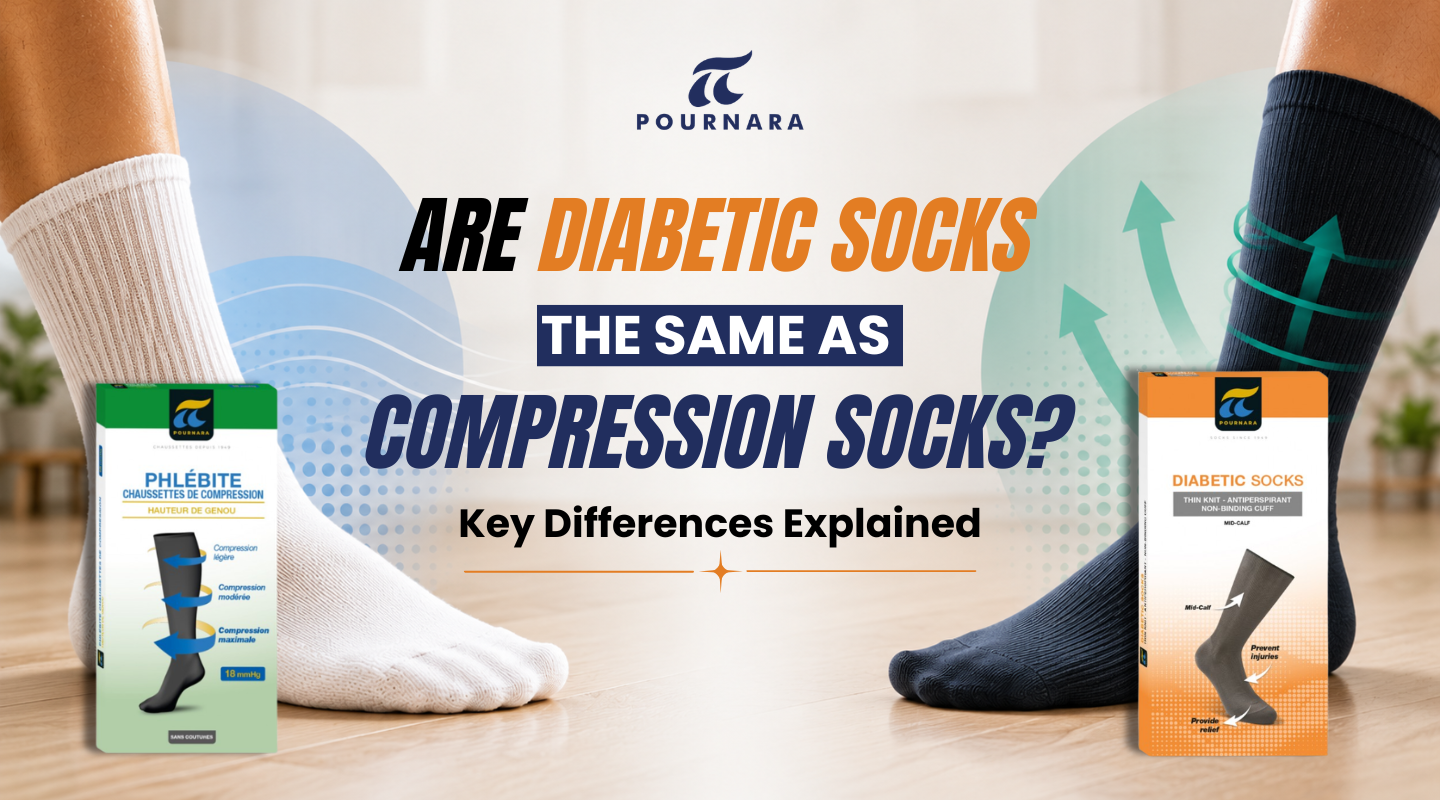
No, diabetic socks and compression socks are not the same. They’re built for different jobs, and if you’ve just been diagnosed with diabetes, mixing them up can actually hurt your feet instead of helping them. Here’s what separates the two and which one you need.
Diabetic socks are designed to protect your feet, not pressure them. Diabetes can affect circulation and nerve sensation over time, so small irritations like a rubbing seam or a damp sock can turn into bigger problems before you notice.
These socks are typically seamless or have flat, minimal seams to reduce friction. Many include extra cushioning around the heel and ball of the foot. The fabric is usually moisture-wicking to keep feet dry and lower infection risk. The tops are loose and non-binding, with no tight elastic digging into your calf and restricting blood flow.
Compression socks apply pressure to your legs, not protection to your skin. They use graduated compression, tighter at the ankle and gradually looser up the leg, to help push blood back toward your heart.
This pressure can reduce swelling, ease achy legs, and lower the risk of blood clots like deep vein thrombosis (DVT). Compression strength is measured in mmHg. Mild options run around 8 to 15 mmHg, with medical grade compression going much higher. Pournara’s medical compression socks are made in Greece with this kind of graduated support in mind, designed for all day wear without sacrificing comfort.
The two sock types differ in nearly every category that matters:
Diabetic socks protect. Compression socks compress. That’s the core difference.
Ask your doctor first. That’s the honest answer here. Diabetes can come with poor circulation or nerve damage (neuropathy), and standard compression socks, especially higher mmHg levels, can restrict blood flow more than some feet can safely handle.
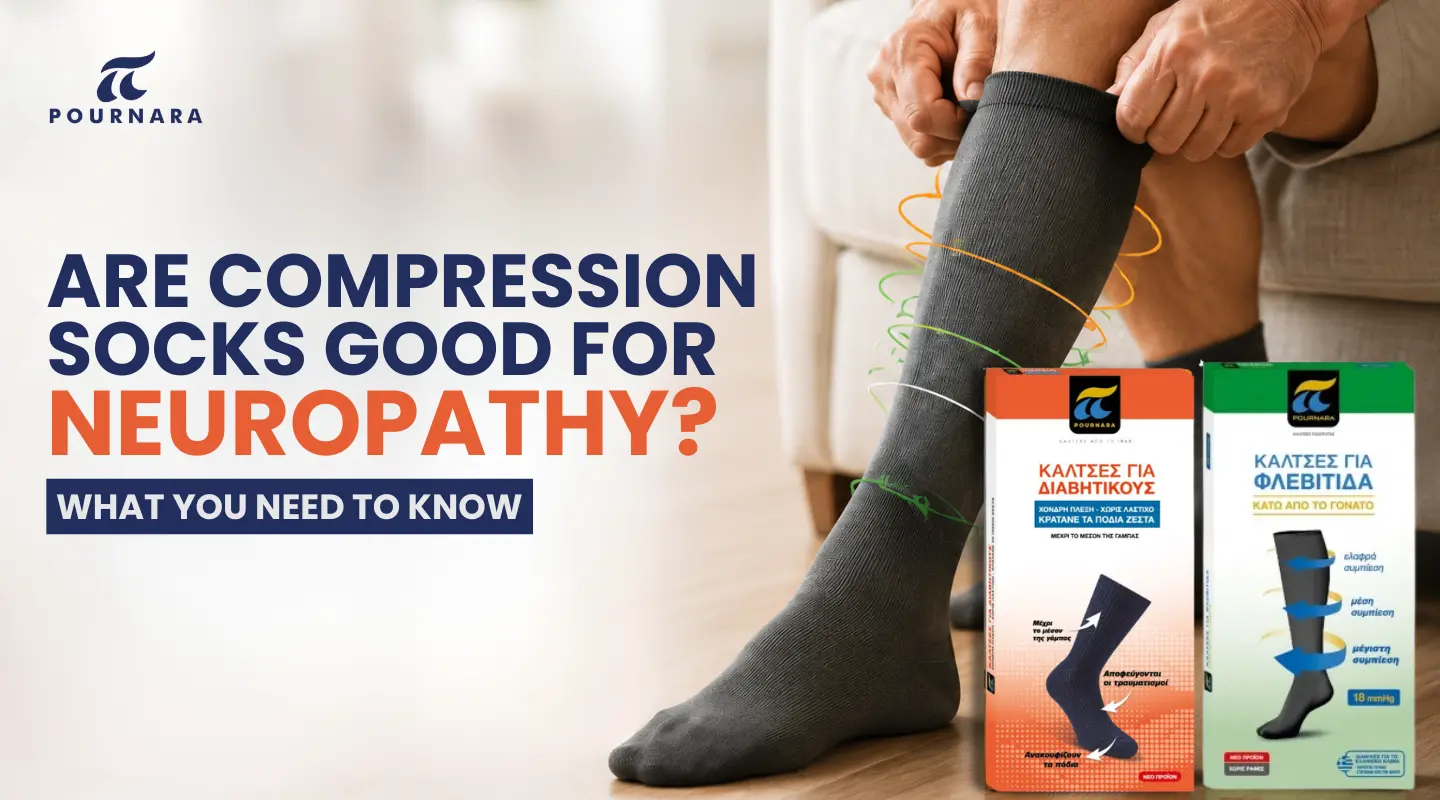
A podiatrist or doctor can check your circulation and recommend a safe mmHg range. Mild compression is sometimes fine, but don’t assume an off the shelf pair is diabetes friendly. If swelling has you considering compression socks, get that confirmed before you buy. If neuropathy is part of your situation, our guide on compression socks and neuropathy covers that question in more depth.
Yes, hybrid options exist. Some brands make diabetic friendly compression socks that combine seamless toes, moisture-wicking fabric, and cushioned soles with a light, doctor-approved level of compression.
These aren’t the same as standard compression socks. They’re engineered specifically for diabetic feet, usually at a gentler mmHg level, without the tight constricting bands found in regular compression wear. If your doctor mentioned you could benefit from some compression but you still need diabetic-grade protection, ask about this category by name.
Match the sock to the problem you’re actually trying to solve:
If you’re newly diagnosed, don’t skip this step. The right sock makes a real difference, and a five-minute conversation with your doctor can prevent a much bigger problem later.
No. Diabetic socks are loose by design, so they don’t apply the pressure needed to reduce swelling. That’s what compression socks do.
Sometimes, depending on circulation and nerve health. Check with a doctor first, since the wrong pressure level can be risky for some diabetic feet.
There’s no single number. Many doctors start diabetic patients on mild compression (8 to 15 mmHg), but you need a personal recommendation, not a guess.
Standard diabetic socks don’t. Hybrid diabetic compression socks do, but at a much gentler level than typical compression wear.
Identify your main issue first. Blister and irritation protection points to diabetic socks. Swelling or circulation concerns point to compression socks with doctor approval. If you have both, ask about a hybrid option.
Diabetic socks and compression socks are not the same, even though people often group them together. Diabetic socks protect. Compression socks compress. If you’re newly diagnosed, start with proper diabetic socks for daily wear and check with your doctor before adding compression. Once you have the green light, Pournara’s medical compression socks are crafted in Greece for the comfort and support your feet need to get through the day.
Pournara
We firmly believe that the internet should be available and accessible to anyone, and are committed to providing a website that is accessible to the widest possible audience, regardless of circumstance and ability.
To fulfill this, we aim to adhere as strictly as possible to the World Wide Web Consortium’s (W3C) Web Content Accessibility Guidelines 2.1 (WCAG 2.1) at the AA level. These guidelines explain how to make web content accessible to people with a wide array of disabilities. Complying with those guidelines helps us ensure that the website is accessible to all people: blind people, people with motor impairments, visual impairment, cognitive disabilities, and more.
This website utilizes various technologies that are meant to make it as accessible as possible at all times. We utilize an accessibility interface that allows persons with specific disabilities to adjust the website’s UI (user interface) and design it to their personal needs.
Additionally, the website utilizes an AI-based application that runs in the background and optimizes its accessibility level constantly. This application remediates the website’s HTML, adapts Its functionality and behavior for screen-readers used by the blind users, and for keyboard functions used by individuals with motor impairments.
If you’ve found a malfunction or have ideas for improvement, we’ll be happy to hear from you. You can reach out to the website’s operators by using the following email
Our website implements the ARIA attributes (Accessible Rich Internet Applications) technique, alongside various different behavioral changes, to ensure blind users visiting with screen-readers are able to read, comprehend, and enjoy the website’s functions. As soon as a user with a screen-reader enters your site, they immediately receive a prompt to enter the Screen-Reader Profile so they can browse and operate your site effectively. Here’s how our website covers some of the most important screen-reader requirements, alongside console screenshots of code examples:
Screen-reader optimization: we run a background process that learns the website’s components from top to bottom, to ensure ongoing compliance even when updating the website. In this process, we provide screen-readers with meaningful data using the ARIA set of attributes. For example, we provide accurate form labels; descriptions for actionable icons (social media icons, search icons, cart icons, etc.); validation guidance for form inputs; element roles such as buttons, menus, modal dialogues (popups), and others. Additionally, the background process scans all the website’s images and provides an accurate and meaningful image-object-recognition-based description as an ALT (alternate text) tag for images that are not described. It will also extract texts that are embedded within the image, using an OCR (optical character recognition) technology. To turn on screen-reader adjustments at any time, users need only to press the Alt+1 keyboard combination. Screen-reader users also get automatic announcements to turn the Screen-reader mode on as soon as they enter the website.
These adjustments are compatible with all popular screen readers, including JAWS and NVDA.
Keyboard navigation optimization: The background process also adjusts the website’s HTML, and adds various behaviors using JavaScript code to make the website operable by the keyboard. This includes the ability to navigate the website using the Tab and Shift+Tab keys, operate dropdowns with the arrow keys, close them with Esc, trigger buttons and links using the Enter key, navigate between radio and checkbox elements using the arrow keys, and fill them in with the Spacebar or Enter key.Additionally, keyboard users will find quick-navigation and content-skip menus, available at any time by clicking Alt+1, or as the first elements of the site while navigating with the keyboard. The background process also handles triggered popups by moving the keyboard focus towards them as soon as they appear, and not allow the focus drift outside it.
Users can also use shortcuts such as “M” (menus), “H” (headings), “F” (forms), “B” (buttons), and “G” (graphics) to jump to specific elements.
We aim to support the widest array of browsers and assistive technologies as possible, so our users can choose the best fitting tools for them, with as few limitations as possible. Therefore, we have worked very hard to be able to support all major systems that comprise over 95% of the user market share including Google Chrome, Mozilla Firefox, Apple Safari, Opera and Microsoft Edge, JAWS and NVDA (screen readers).
Despite our very best efforts to allow anybody to adjust the website to their needs. There may still be pages or sections that are not fully accessible, are in the process of becoming accessible, or are lacking an adequate technological solution to make them accessible. Still, we are continually improving our accessibility, adding, updating and improving its options and features, and developing and adopting new technologies. All this is meant to reach the optimal level of accessibility, following technological advancements. For any assistance, please reach out to