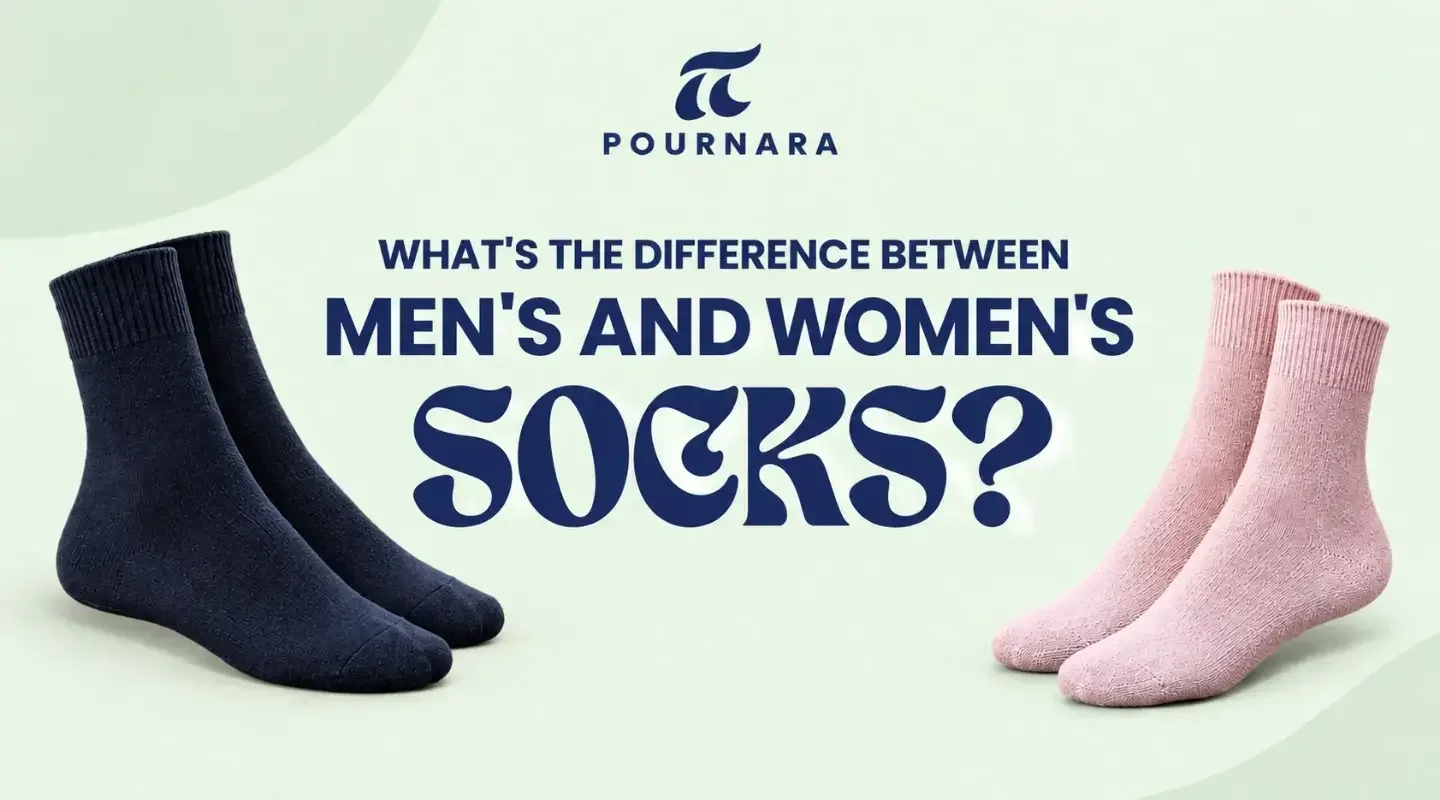
Men’s and women’s socks differ in four main ways: sizing, cuff or welt height, toe box and heel shape, and fabric weight. These differences trace back to measurable, average anatomical differences between male and female feet, documented in foot-shape studies from Foot & Ankle International and the Journal of the American Podiatric Medical Association. Color, pattern, and length variety, on the other hand, come down to retail tradition rather than anatomy.
If you’ve ever wondered why a “unisex” sock never quite fits the way a gender-labeled one does, or whether it’s fine to buy your partner’s socks instead of your own, here’s what’s actually different, what’s just convention, and how to use that to buy socks that fit.
Sock sizing started as a response to average differences in foot shape between men and women, differences that biomechanics researchers have measured directly.
A study published in Foot & Ankle International by Wunderlich and Cavanagh compared foot dimensions across a large sample of adults and found that men have longer and broader feet than women, even after adjusting for height. The difference isn’t just that men tend to be taller: foot width and length scale differently between the sexes on their own.
A separate foot-shape comparison published in the Journal of the American Podiatric Medical Association measured heel-to-ball length directly: an average of 181.5 mm for male participants compared to 165.0 mm for female participants. The same study found that women’s feet were narrower at the ball, instep, and heel, but slightly higher through the arch and instep than men’s feet of the same length.
Sock manufacturers design around these averages. That’s why a sock built on a “men’s” last (the foot-shaped form used in construction) fits differently than one built on a “women’s” last, even at a labeled size that seems equivalent. These are population averages, not rules (not every man has wider feet than every woman), but they’re the reason sizing charts split the way they do.
| Category | US Shoe Size | Typical Sock Size Label |
| Women’s | 4 to 10 | Small (4–6), Medium (6–9), Large (9–11) |
| Men’s | 7 to 13 | Medium (7–9), Large (9–12), X-Large (12–15) |
| Overlap zone | 7 to 10 | Either label can work; fit varies by brand |
Most sizing confusion happens in that overlap zone, roughly a women’s shoe size 8 to 10, which lines up with a men’s 6.5 to 8.5. In that range, either a women’s large or a men’s medium might fit, but they won’t fit the same way: the women’s version will hug more snugly through the arch and heel, while the men’s version will have more room in the toe box and a looser overall foot bed. It’s a matter of which shape matches your actual foot, not which is “correct.”
Cuff and welt height. The welt is the elastic band at the top of the sock. Men’s dress and crew socks typically use a taller, firmer welt, sized for a larger average calf circumference and built to keep the sock from sliding down inside dress shoes or boots over a full workday. Women’s socks generally use a shorter, lighter welt, since the average calf circumference at a given sock size is smaller.
Toe box and heel pocket. Following the same anatomical pattern above, men’s socks use a wider, deeper toe box for a broader forefoot, while women’s socks use a narrower, more contoured toe box built around a narrower average forefoot and higher instep.
Fabric weight and density. Men’s dress and work socks are frequently knit at a heavier gauge, since men’s footwear (dress shoes, work boots) tends to run structurally heavier, and a denser knit holds its shape longer inside stiffer shoes. Women’s socks more often use a lighter knit, prioritizing a closer, more flexible fit across flats, boots, and heels.
Color, pattern, and length variety are retail convention, not anatomy: the same segmentation pattern seen in shirts and outerwear. Women’s socks are typically offered in a wider range of colors, patterns, and finishes (sheer, ribbed, lace-trimmed), while men’s socks lean toward solid colors and classic patterns like argyle or stripes.
Length proportions differ too. Men’s lines concentrate around crew and calf-length options suited to trousers and boots. Women’s lines spread further across no-show, ankle, knee-high, and trouser sock styles, reflecting a wider range of paired footwear.
Performance features like moisture-wicking, cushioning, and compression aren’t inherently gendered: a moisture-wicking fiber blend works the same way regardless of sizing chart. What varies by sex, on average, is how much surface area and cushioning placement the sock needs to match the underlying foot shape.
So the more useful shopping question is often what the sock is for, not which label it carries. A compression sock for all-day standing needs graduated pressure and a reinforced heel regardless of gender labeling. A wool sock for long-haul travel needs breathability and a snug arch fit, same rule. Gendered sizing gets you the right starting shape; material and construction get you the right performance for the activity.
Yes, plenty of people do, usually because their foot dimensions sit outside the “typical” range for their gender’s sizing chart, or because they prefer the fit or style of the other line.
Women with longer or wider feet than a standard women’s chart often find a better fit in a men’s small or medium, particularly through the toe box and ball of the foot. Some brands market specific styles as fitting “up” into men’s ranges for exactly this reason.
Men with narrower or smaller feet than a standard men’s small accommodates may find a closer, more secure fit in a women’s large, especially through the arch and heel, where women’s lasts are built with a snugger contour.
Unisex socks split the difference with a middle-ground last that isn’t optimized for either average foot shape. That makes them a flexible option for bulk buying or for feet that don’t map cleanly to either chart, though they generally won’t fit as precisely as a correctly matched gendered sock.
| Feature | Men’s Socks | Women’s Socks |
| Average foot length basis | ~181.5 mm heel-to-ball | ~165.0 mm heel-to-ball |
| Toe box | Wider, deeper | Narrower, more contoured |
| Welt/cuff height | Taller, firmer | Shorter, lighter |
| Fabric gauge | Often heavier | Often lighter |
| Color and pattern range | Narrower, classic | Broader, more varied |
| Length variety | Concentrated in crew/calf | Spread across no-show to knee-high |
If any of this has you second-guessing which size you’ve been buying, check your measurements against a real sizing chart rather than relying on habit. Pournara’s men’s and women’s lines are built on separate lasts for the reasons above: different toe box shapes, welt heights, and fabric weights across collections like Anesis, Classic, and Wool. Browsing both lines side by side is a quick way to see how these construction differences actually feel in a finished sock, whether you’re shopping for yourself or for someone whose foot shape doesn’t match the label they’d normally reach for.
Pournara
We firmly believe that the internet should be available and accessible to anyone, and are committed to providing a website that is accessible to the widest possible audience, regardless of circumstance and ability.
To fulfill this, we aim to adhere as strictly as possible to the World Wide Web Consortium’s (W3C) Web Content Accessibility Guidelines 2.1 (WCAG 2.1) at the AA level. These guidelines explain how to make web content accessible to people with a wide array of disabilities. Complying with those guidelines helps us ensure that the website is accessible to all people: blind people, people with motor impairments, visual impairment, cognitive disabilities, and more.
This website utilizes various technologies that are meant to make it as accessible as possible at all times. We utilize an accessibility interface that allows persons with specific disabilities to adjust the website’s UI (user interface) and design it to their personal needs.
Additionally, the website utilizes an AI-based application that runs in the background and optimizes its accessibility level constantly. This application remediates the website’s HTML, adapts Its functionality and behavior for screen-readers used by the blind users, and for keyboard functions used by individuals with motor impairments.
If you’ve found a malfunction or have ideas for improvement, we’ll be happy to hear from you. You can reach out to the website’s operators by using the following email
Our website implements the ARIA attributes (Accessible Rich Internet Applications) technique, alongside various different behavioral changes, to ensure blind users visiting with screen-readers are able to read, comprehend, and enjoy the website’s functions. As soon as a user with a screen-reader enters your site, they immediately receive a prompt to enter the Screen-Reader Profile so they can browse and operate your site effectively. Here’s how our website covers some of the most important screen-reader requirements, alongside console screenshots of code examples:
Screen-reader optimization: we run a background process that learns the website’s components from top to bottom, to ensure ongoing compliance even when updating the website. In this process, we provide screen-readers with meaningful data using the ARIA set of attributes. For example, we provide accurate form labels; descriptions for actionable icons (social media icons, search icons, cart icons, etc.); validation guidance for form inputs; element roles such as buttons, menus, modal dialogues (popups), and others. Additionally, the background process scans all the website’s images and provides an accurate and meaningful image-object-recognition-based description as an ALT (alternate text) tag for images that are not described. It will also extract texts that are embedded within the image, using an OCR (optical character recognition) technology. To turn on screen-reader adjustments at any time, users need only to press the Alt+1 keyboard combination. Screen-reader users also get automatic announcements to turn the Screen-reader mode on as soon as they enter the website.
These adjustments are compatible with all popular screen readers, including JAWS and NVDA.
Keyboard navigation optimization: The background process also adjusts the website’s HTML, and adds various behaviors using JavaScript code to make the website operable by the keyboard. This includes the ability to navigate the website using the Tab and Shift+Tab keys, operate dropdowns with the arrow keys, close them with Esc, trigger buttons and links using the Enter key, navigate between radio and checkbox elements using the arrow keys, and fill them in with the Spacebar or Enter key.Additionally, keyboard users will find quick-navigation and content-skip menus, available at any time by clicking Alt+1, or as the first elements of the site while navigating with the keyboard. The background process also handles triggered popups by moving the keyboard focus towards them as soon as they appear, and not allow the focus drift outside it.
Users can also use shortcuts such as “M” (menus), “H” (headings), “F” (forms), “B” (buttons), and “G” (graphics) to jump to specific elements.
We aim to support the widest array of browsers and assistive technologies as possible, so our users can choose the best fitting tools for them, with as few limitations as possible. Therefore, we have worked very hard to be able to support all major systems that comprise over 95% of the user market share including Google Chrome, Mozilla Firefox, Apple Safari, Opera and Microsoft Edge, JAWS and NVDA (screen readers).
Despite our very best efforts to allow anybody to adjust the website to their needs. There may still be pages or sections that are not fully accessible, are in the process of becoming accessible, or are lacking an adequate technological solution to make them accessible. Still, we are continually improving our accessibility, adding, updating and improving its options and features, and developing and adopting new technologies. All this is meant to reach the optimal level of accessibility, following technological advancements. For any assistance, please reach out to