
If you have ever held two pairs of compression socks in a store, one marked 15-20 mmHg and the other 20-30 mmHg, you know how confusing the numbers can be. Pick too low and the socks do very little. Pick too high and they can feel painfully tight. This guide explains what mmHg compression socks are, which level suits your daily routine, and when to ask a doctor before you buy.
Quick answer: For most healthy adults, 15-20 mmHg compression socks are the right starting point for everyday wear, travel and long days on your feet. Choose 8-15 mmHg for light leg fatigue, 20-30 mmHg for moderate swelling or varicose veins, and 30 mmHg or higher only with a doctor’s guidance. If you have diabetes, poor circulation or leg pain, check with your doctor first.
Key takeaways
This article is for general education and is not medical advice. Talk with your doctor if you have a health condition or ongoing leg symptoms.
The abbreviation mmHg stands for millimeters of mercury, the same unit used for blood pressure readings. Compression socks contain no mercury. The number simply describes how much pressure the sock puts on your leg, and it is usually measured at the ankle, where the sock is tightest. A higher number means a firmer squeeze.
Most useful compression socks are graduated. They are tightest at the ankle and ease off as they climb the leg, which helps move blood back toward the heart instead of letting it settle in the lower leg. Sigvaris, a compression manufacturer, explains that graduated designs are the more beneficial type compared with uniform ones, which squeeze evenly from top to bottom.
Regular socks apply no meaningful pressure. Light support socks usually sit in the 8-15 mmHg range, while true compression socks start around 15 mmHg and go up from there. Labels such as support, medical or therapeutic are not standardized, and countries and brands group pressure levels differently. Rely on the mmHg number printed on the package or product page, not the marketing term.
Common ratings run from 8-15 mmHg up to 50-60 mmHg, according to a patient handout from UW Health. Here is how the main levels compare in everyday terms.
| Level | How it feels | Common uses | Prescription? |
|---|---|---|---|
| 8-15 mmHg | Light, close to a snug sock | Tired legs, everyday wear, short trips | No |
| 15-20 mmHg | Moderate, a gentle hug | Travel, desk jobs, long days on your feet, mild swelling | Usually no |
| 20-30 mmHg | Firm | Moderate swelling, varicose veins, recovery after some vein treatments | Doctor’s guidance recommended |
| 30-40 mmHg | Extra firm | Significant swelling and other conditions diagnosed by a doctor | Usually prescribed or fitted |
| 40-50 mmHg and above | Very firm | Severe vein disease and lymphedema | Prescribed and fitted |
This is the lightest level. It suits mild leg tiredness, a little extra support through a normal day, and short trips. Most people can wear it for hours without discomfort.
This is the level you will find most often in drugstores and online shops. Sigvaris notes that over-the-counter compression usually lands around 15-20 mmHg. It works well for desk days, travel, long shifts on your feet and mild end-of-day swelling. If you are new to compression, begin here. Firmer is not automatically better, and a level that is too strong for your needs can leave your legs sore.
According to Sigvaris, this is the level doctors prescribe most often. It is used for moderate swelling, varicose veins and recovery after some vein procedures. Some people who spend eight or more hours on their feet try it when 15-20 mmHg does not feel like enough. The socks are harder to pull on, and anyone with a circulation or heart condition should talk with a doctor before choosing this level.
This level is meant for specific medical needs, such as significant swelling or support after certain procedures. It is rarely sold as a general comfort sock, and fit matters a great deal, so a doctor or trained fitter should guide the choice.
These ratings are reserved for severe vein disease and lymphedema. They are prescribed, professionally fitted and monitored. Do not choose this range on your own.
If you sit most of the day and your legs feel heavy by evening, start with 8-15 mmHg. Move up to 15-20 mmHg if the lighter level does not help.
Nurses, teachers, retail staff and hospitality workers often finish a shift with aching legs. Try 15-20 mmHg first, then 20-30 mmHg if symptoms continue. Cushioning and fit matter as much as the number, and our guide to the best socks for standing all day covers both.
Sitting for hours slows blood flow in the legs. A Cochrane review of randomized trials in passengers on flights of at least four hours found high-certainty evidence that compression stockings reduce symptomless DVT, and low-certainty evidence that they reduce leg swelling. In its summary for clinicians, the American Academy of Family Physicians estimated that about 37 high-risk travelers, or about 111 low-risk travelers, would need to wear stockings to prevent one symptomless clot. It also noted that it is unclear whether stockings prevent clots with symptoms, lung clots or death.
Guidelines differ. NIHR Evidence reports that NICE recommends stockings for people at moderate or high risk on long flights, while the Scottish SIGN guideline does not routinely recommend them. Retail guides also disagree on whether 8-15 or 15-20 mmHg is better for flying, and the trials used below-the-knee stockings. If you have had a blood clot, have a strong family history of clots or have a condition that limits movement, talk with your doctor before a long trip. Walking the aisle when you can and staying hydrated help no matter which socks you wear.
Want to see what a supportive everyday sock looks like? Browse our medical socks for men and check the compression level listed in each product’s details.
Mild ankle puffiness at the end of a long day often responds to 15-20 mmHg. Swelling that is constant, painful or limited to one leg needs a medical check, not just a new pair of socks. Sudden swelling in one leg with pain, warmth or redness can signal a blood clot and needs urgent care. If you are pregnant or have varicose veins, ask your doctor or midwife which level is right for you.
Many athletes wear compression socks during or after hard sessions because their legs feel better. Treat it as a comfort choice rather than a guaranteed performance boost, and start with 15-20 mmHg if you are new.
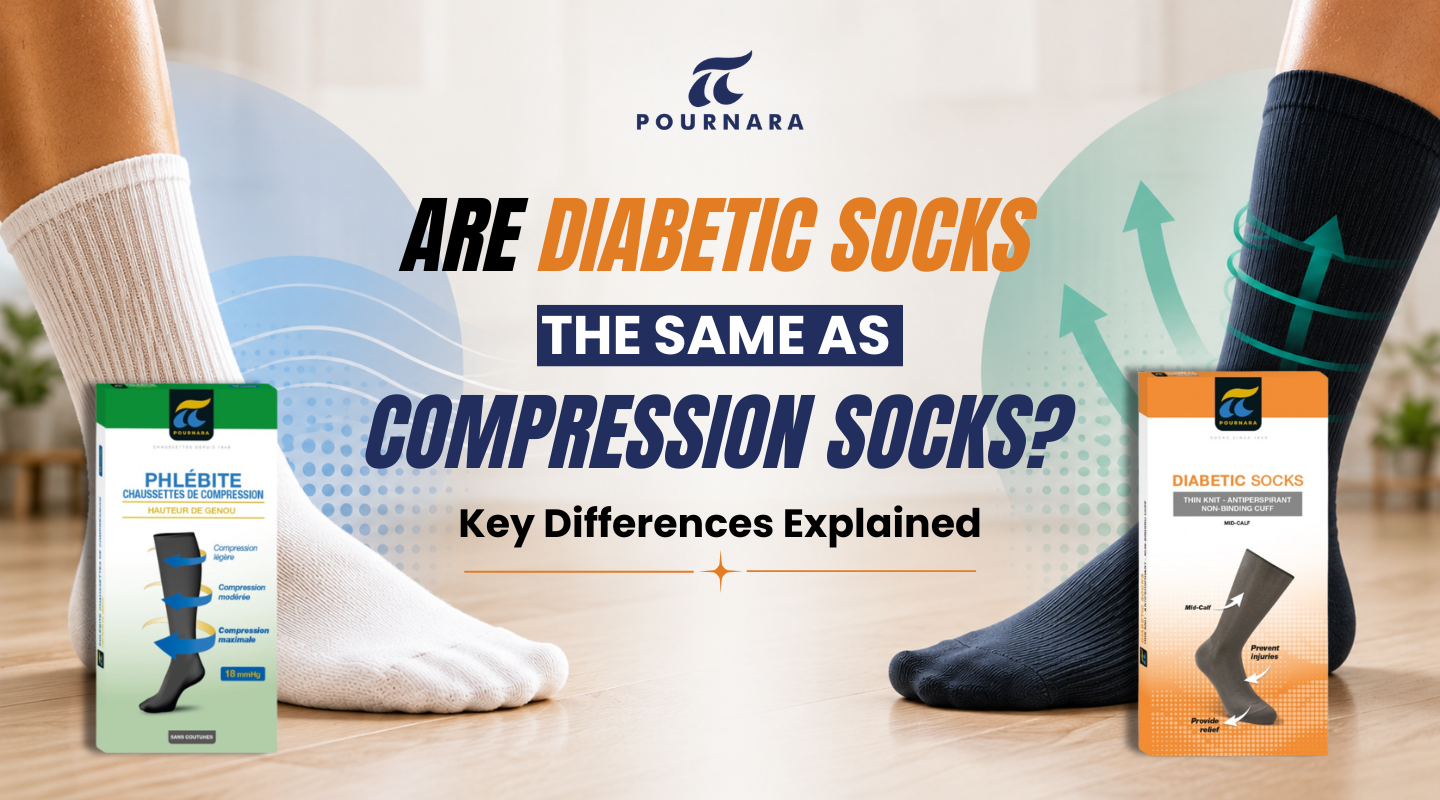
Not for lighter levels. Sigvaris says lower-pressure stockings are sold at drugstores, medical supply stores and online without a prescription, usually around 15-20 mmHg, while higher levels are prescribed by doctors. It adds that 20-30 mmHg and 30-40 mmHg are generally safe but can harm people with certain conditions, so a doctor’s oversight is recommended. As a rule, see a doctor first if you want 20 mmHg or higher, if you have diabetes, or if you are treating a diagnosed condition. If you have diabetes, our article on whether diabetic socks are the same as compression socks explains the differences.
Compression helps many people, but it is not right for everyone. Talk with a doctor before wearing compression socks if any of these apply:
Take the socks off and call your doctor if you notice pain, numbness, tingling or color changes in your toes. The UW Health handout puts it simply: compression stockings should feel tight, but they should not hurt.
Most brands are sized by ankle and calf circumference, and some also ask for leg length. Measure your ankle at its narrowest point and your calf at its widest, ideally in the morning before swelling builds. Compare the numbers with the size chart of the brand you are buying, because sizing varies between makers. Men’s and women’s socks are also cut differently, and our guide to the difference between men’s and women’s socks explains why that matters for fit.
Too tight means pain, numbness, tingling, toes that change color, or a band that digs in and leaves deep marks. Too loose means the socks slide down, bunch at the ankle or feel like ordinary socks. The right pair feels snug and supportive from the first minute.
Most people put them on in the morning and take them off at bedtime unless a doctor advises otherwise. If you are curious about sleeping in them, read our article on compression socks and restless leg syndrome, which also answers whether you can sleep in them. The elastic wears down with use, and many manufacturers suggest replacing regularly worn pairs every three to six months. Check the care label and wash them as directed.
Once you know your level, the sock itself matters. Pournara socks are made in Greece with a focus on fit, softness and durability, and our medical socks for men collection is built for supportive comfort through a long day. Check the product details for the compression level before you order, and use our support page if you want help matching a level to your routine. If the fit is not right, our returns and exchanges page has the details.
If you do not need compression, our 100% mercerized cotton socks for men and soft bamboo socks are made for everyday comfort, and our women’s collection has options too. If sweaty feet are the real problem, read our honest review of antiperspirant socks before you buy anything.
We sell socks, so we have a stake in this topic. The guidance above applies to any brand, and your doctor’s advice always comes first.
Ready to try a pair? Browse the medical socks for men collection at your own pace and see what fits your day.
Neither is better for everyone. Start with 15-20 mmHg for everyday comfort, travel and mild swelling. Move to 20-30 mmHg if symptoms continue or your doctor recommends it.
Many travelers choose 15-20 mmHg, and some pick 8-15 mmHg for shorter flights. The Cochrane research covered flights of four hours or more. If you have a history of clots, ask your doctor first.
Most people wear them through the day and remove them at night, unless a doctor says otherwise. Our guide to sleeping in compression socks covers the details.
It is firm and meant for specific medical needs. If a doctor recommended it and it was fitted properly, it can be right. For general comfort it is usually more than you need.
Often not to buy them, but a doctor’s guidance is wise because certain conditions make firm compression risky. Levels of 30 mmHg and above are usually prescribed.
Pain, numbness, tingling, color changes in your toes or deep marks that linger mean the socks are too tight or the wrong size. Take them off and call your doctor if symptoms continue.
Many makers suggest every three to six months with regular wear. Replace them sooner if they lose their snug feel, stretch out or develop thin spots.
The right mmHg level comes down to your daily routine and your health. For most healthy adults, 15-20 mmHg is a sensible place to start, 8-15 mmHg suits lighter needs, and anything at 20-30 mmHg or higher deserves a conversation with your doctor. Measure carefully, choose a comfortable fit and never ignore pain or numbness.
Still unsure which level fits you? Our support team is happy to answer questions about fit and sizing, and you can find more guides on our blog. This article is general education, not medical advice.
Pournara
We firmly believe that the internet should be available and accessible to anyone, and are committed to providing a website that is accessible to the widest possible audience, regardless of circumstance and ability.
To fulfill this, we aim to adhere as strictly as possible to the World Wide Web Consortium’s (W3C) Web Content Accessibility Guidelines 2.1 (WCAG 2.1) at the AA level. These guidelines explain how to make web content accessible to people with a wide array of disabilities. Complying with those guidelines helps us ensure that the website is accessible to all people: blind people, people with motor impairments, visual impairment, cognitive disabilities, and more.
This website utilizes various technologies that are meant to make it as accessible as possible at all times. We utilize an accessibility interface that allows persons with specific disabilities to adjust the website’s UI (user interface) and design it to their personal needs.
Additionally, the website utilizes an AI-based application that runs in the background and optimizes its accessibility level constantly. This application remediates the website’s HTML, adapts Its functionality and behavior for screen-readers used by the blind users, and for keyboard functions used by individuals with motor impairments.
If you’ve found a malfunction or have ideas for improvement, we’ll be happy to hear from you. You can reach out to the website’s operators by using the following email
Our website implements the ARIA attributes (Accessible Rich Internet Applications) technique, alongside various different behavioral changes, to ensure blind users visiting with screen-readers are able to read, comprehend, and enjoy the website’s functions. As soon as a user with a screen-reader enters your site, they immediately receive a prompt to enter the Screen-Reader Profile so they can browse and operate your site effectively. Here’s how our website covers some of the most important screen-reader requirements, alongside console screenshots of code examples:
Screen-reader optimization: we run a background process that learns the website’s components from top to bottom, to ensure ongoing compliance even when updating the website. In this process, we provide screen-readers with meaningful data using the ARIA set of attributes. For example, we provide accurate form labels; descriptions for actionable icons (social media icons, search icons, cart icons, etc.); validation guidance for form inputs; element roles such as buttons, menus, modal dialogues (popups), and others. Additionally, the background process scans all the website’s images and provides an accurate and meaningful image-object-recognition-based description as an ALT (alternate text) tag for images that are not described. It will also extract texts that are embedded within the image, using an OCR (optical character recognition) technology. To turn on screen-reader adjustments at any time, users need only to press the Alt+1 keyboard combination. Screen-reader users also get automatic announcements to turn the Screen-reader mode on as soon as they enter the website.
These adjustments are compatible with all popular screen readers, including JAWS and NVDA.
Keyboard navigation optimization: The background process also adjusts the website’s HTML, and adds various behaviors using JavaScript code to make the website operable by the keyboard. This includes the ability to navigate the website using the Tab and Shift+Tab keys, operate dropdowns with the arrow keys, close them with Esc, trigger buttons and links using the Enter key, navigate between radio and checkbox elements using the arrow keys, and fill them in with the Spacebar or Enter key.Additionally, keyboard users will find quick-navigation and content-skip menus, available at any time by clicking Alt+1, or as the first elements of the site while navigating with the keyboard. The background process also handles triggered popups by moving the keyboard focus towards them as soon as they appear, and not allow the focus drift outside it.
Users can also use shortcuts such as “M” (menus), “H” (headings), “F” (forms), “B” (buttons), and “G” (graphics) to jump to specific elements.
We aim to support the widest array of browsers and assistive technologies as possible, so our users can choose the best fitting tools for them, with as few limitations as possible. Therefore, we have worked very hard to be able to support all major systems that comprise over 95% of the user market share including Google Chrome, Mozilla Firefox, Apple Safari, Opera and Microsoft Edge, JAWS and NVDA (screen readers).
Despite our very best efforts to allow anybody to adjust the website to their needs. There may still be pages or sections that are not fully accessible, are in the process of becoming accessible, or are lacking an adequate technological solution to make them accessible. Still, we are continually improving our accessibility, adding, updating and improving its options and features, and developing and adopting new technologies. All this is meant to reach the optimal level of accessibility, following technological advancements. For any assistance, please reach out to